
How to Make Classic Sourdough Bread: A Complete Guide
There is something deeply satisfying about pulling a classic sourdough loaf from the oven. The crackle of the crust as it cools. The open, chewy crumb inside. The flavour that no supermarket bread has ever come close to matching.
But if you have tried making sourdough before and ended up with a dense brick, a flat frisbee, or something that tasted like vinegar, you are not alone. Classic sourdough is one of the most rewarding things you can bake — and one of the most misunderstood.
This guide covers the full process from end to end. By the time you finish reading, you will understand not just what to do at each stage, but why — and that understanding is what separates bakers who get consistent results from those who stay stuck.
If you are brand new to sourdough, it may help to start with The Complete Beginner's Guide to Sourdough Bread before diving into this. And if you do not yet have an active starter, our guide on How to Make a Sourdough Starter from Scratch will get you there.
What Makes Classic Sourdough Different From Other Bread?
Classic sourdough uses no commercial yeast. Instead, it relies entirely on a live culture — your starter — made from wild yeast and lactic acid bacteria. These microorganisms ferment the dough, producing the gas that makes it rise and the acids that give sourdough its characteristic tang.
This is why sourdough takes longer than a standard loaf. Fermentation times are measured in hours, not minutes. But that slow process does more than just raise the dough. It breaks down phytic acid, which makes the minerals in flour more bioavailable. It partially pre-digests gluten proteins. And it builds layers of flavour complexity that fast-rise bread simply cannot develop.
The result is a loaf that looks, tastes, and performs differently from anything made with commercial yeast — and one that improves with every bake.
The Equipment You Will Need
Before you start, make sure you have the following:
- Kitchen scales — Sourdough baking is done by weight, not by cups. Accuracy matters.
- Large mixing bowl — At least 4 litres to give the dough room during bulk fermentation.
- Banneton (proofing basket) — A round or oval basket lined with flour that gives the dough shape during its final proof. See our Banneton and Proofing Basket Guide if you need one.
- Dutch oven — The single most important piece of equipment for getting great oven spring and crust. A cast iron pot with a lid traps steam around the loaf in the critical first phase of baking. Read our full breakdown in Dutch Oven Sourdough: Why Steam Matters.
- Bench scraper — Invaluable for handling and shaping dough without it sticking to everything.
- Lame or sharp razor blade — For scoring the top of the loaf before it goes into the oven.
- Dough thermometer — Optional but useful for monitoring fermentation temperature.
The Ingredients
Classic sourdough uses just four ingredients: flour, water, salt, and your active starter. The quality and ratios of these ingredients matter far more than any technique. Here is what each one contributes:
Flour: Most classic sourdoughs use a blend of strong white bread flour and a smaller proportion of wholemeal or rye flour. The white flour provides the gluten strength needed for structure and oven spring, while the wholemeal adds flavour depth and feeds the fermentation a little more actively. See The Best Flour for Sourdough Bread for a detailed breakdown of your options.
Water: Room temperature water works well for most kitchens. If your tap water is heavily chlorinated, letting it sit for 30 minutes before using — or filtering it — removes most of the chlorine that could interfere with your starter. Our guide on Water Quality for Sourdough explains exactly how much this matters (and when it does not).
Salt: Fine sea salt is added after the starter has been incorporated. This is deliberate — salt inhibits fermentation, so giving the wild yeast a head start before salt is introduced leads to more active, better-flavoured dough.
Starter: Your starter should be active, bubbly, and at or just past its peak when you use it. If you are unsure whether yours is ready, read How to Know When Your Sourdough Starter Is Ready to Bake With.
The specific ratios — how much water relative to flour (hydration), how much starter, how much salt — are variables that significantly shape the final result. Finding the balance that works with your flour, your starter, and your kitchen environment is a core part of the learning process. Understanding baker's percentages is how professional bakers communicate and adjust these ratios precisely.
The Full Timeline at a Glance
Sourdough does not demand constant attention, but it does demand your time in small doses across a long window. Here is what a typical bake looks like:
| Stage | When | Duration |
|---|---|---|
| Feed starter | Night before | 5 minutes |
| Mix dough (autolyse + add starter + add salt) | Morning | 30–40 minutes |
| Bulk fermentation with stretch and folds | Morning to early afternoon | 4–6 hours |
| Pre-shape and bench rest | Afternoon | 30 minutes |
| Final shape and cold proof | Afternoon into next day | 12–16 hours |
| Bake | Next morning | 50 minutes |
Total elapsed time from mixing to slicing: roughly 20–24 hours. Hands-on time: under 2 hours.
Stage 1 — Preparing Your Starter
A well-fed, active starter is the foundation of a good loaf. Feed your starter the evening before you plan to mix your dough and leave it to develop overnight at room temperature. By morning it should have doubled in size, be bubbly throughout, smell yeasty and slightly tangy, and have a domed top.
That peak moment — when the starter is at its most active and gassy — is when it should go into your dough. Using starter that is visibly deflated or smells aggressively sharp means the wild yeast has already exhausted itself and your fermentation timing will be unreliable.
The exact feeding ratio that gives you a reliable peak within your overnight window is something you calibrate to your own starter, your flour, and your kitchen temperature. This is one of those things that sounds straightforward but benefits enormously from hands-on practice.
Stage 2 — Mixing the Dough: Autolyse
The autolyse is one of the simplest and most effective techniques in sourdough baking. Before adding the starter or salt, you mix just the flour and water and leave them to rest.
During this rest — typically 30 to 60 minutes — the flour fully absorbs the water and gluten begins developing passively. When you come back to add the starter, the dough already has noticeably more structure and elasticity. It handles better and holds its shape more effectively during later stages.
The autolyse is optional but highly recommended, especially for beginners. The difference in how the dough feels before and after that rest is one of those things that clicks immediately the first time you experience it.
Stage 3 — Adding the Starter and Salt
After the autolyse, the starter is worked into the dough by hand — squeezing, folding, and turning until fully incorporated and the dough feels uniform. This takes a few minutes. Unevenly distributed starter leads to uneven fermentation.
Salt is added shortly after the starter, typically dissolved in a small amount of water to help it disperse evenly. The dough will feel firm and may slip initially, but will come together as the salt is absorbed.
After the salt is incorporated, bulk fermentation begins.
Stage 4 — Bulk Fermentation
Bulk fermentation is the most important phase in sourdough baking. It is where the yeast produces CO₂ to aerate the dough, where the bacteria produce the flavour compounds, and where the gluten network builds its final strength.
The exact timing depends entirely on the temperature of your dough and the strength of your starter. A colder kitchen means slower fermentation. A very active starter means faster fermentation. You are learning to read the dough, not the clock — though the clock is still a useful guide.
Stretch and Folds
During bulk fermentation, you perform a series of stretch and fold sets. These build strength in the dough without deflating it, and they distribute fermentation gases evenly throughout.
Each set takes about 30 seconds: reach under the dough, stretch it upward, fold it over, rotate the bowl, and repeat around all four sides. A handful of sets during the first couple of hours of bulk fermentation is typical, with the dough then left undisturbed to complete its rise.
How to Know When Bulk Fermentation Is Complete
This is where many bakers go wrong — stopping too early or letting the dough over-ferment. Look for these signs:
- Volume increase: The dough should have grown noticeably — significantly larger than when you started.
- Domed surface: The top of the dough should look domed and slightly jiggly, not flat or collapsed.
- Bubble activity: You should see bubbles on the surface and through the sides if using a clear container.
- Texture: When you tilt the bowl, the dough should move as a single, airy, cohesive mass — not sloppy and slack, and not so gassy it tears easily.
Knowing when to stop bulk fermentation — reading the dough rather than the clock — is one of the most important skills in sourdough baking, and one of the hardest to develop from written instructions alone. Over-fermented dough collapses in the oven; under-fermented dough produces a dense, gummy crumb.
Stage 5 — Pre-Shaping
Pre-shaping is the first of two shaping stages. Its purpose is to build initial tension in the dough and create a rough round that will be easier to final-shape after a short rest.
The dough is gently turned out onto the bench and worked into a round using a bench scraper and your free hand. The key is building surface tension — you want the outer skin of the dough to feel taut, not baggy. After pre-shaping, the dough rests uncovered on the bench for 20 to 30 minutes. This bench rest allows the gluten to relax before the final shaping.
Stage 6 — Final Shape
Final shaping is the step that determines the structure and appearance of your finished loaf. For a detailed walkthrough of technique, see our guide to How to Shape Sourdough Bread (Boule and Batard).
Whether you are shaping a round boule or an oval batard, the goal is the same: a smooth, taut outer surface with visible tension. This surface tension is what gives the loaf structure in the oven. Too loose and the loaf spreads sideways; too rough and the surface tears.
This is one of the tactile skills that is genuinely hard to convey in words. Feeling what "right tension" means in your hands — not too tight, not too slack — is something that clicks with practice. It is also one of the key things our workshop is specifically designed to teach, because an experienced baker standing next to you can identify and correct shaping issues in real time in a way no article can.
Once shaped, the dough goes into a well-floured banneton, seam side up, and is covered for its final proof.
Stage 7 — Cold Proof
Placing the covered banneton in the fridge overnight is strongly recommended for beginners. This slow, cold fermentation does several important things simultaneously:
- It develops flavour. The longer, cooler fermentation allows more complex acids to build.
- It firms the dough, making it significantly easier to score cleanly before baking.
- It gives you flexibility. A dough in a cold fridge will hold for many hours, so you can bake when it suits you rather than to a rigid schedule.
The length of the cold proof is a variable that affects both flavour and structure. Too short and the loaf will taste underdeveloped; too long and the dough risks over-fermenting even at fridge temperatures.
Stage 8 — Scoring and Baking
Preheating the Dutch Oven
Place your Dutch oven, with its lid, in the oven and preheat at maximum temperature for at least 45 minutes before baking. A properly preheated Dutch oven is essential. The intense bottom heat and the trapped steam it creates are what drive oven spring — the dramatic final rise that gives sourdough its open crumb and burst score.
Scoring
The dough goes straight from the fridge to scoring — do not let it come to room temperature first. Cold dough is firmer and holds its shape better under the blade.
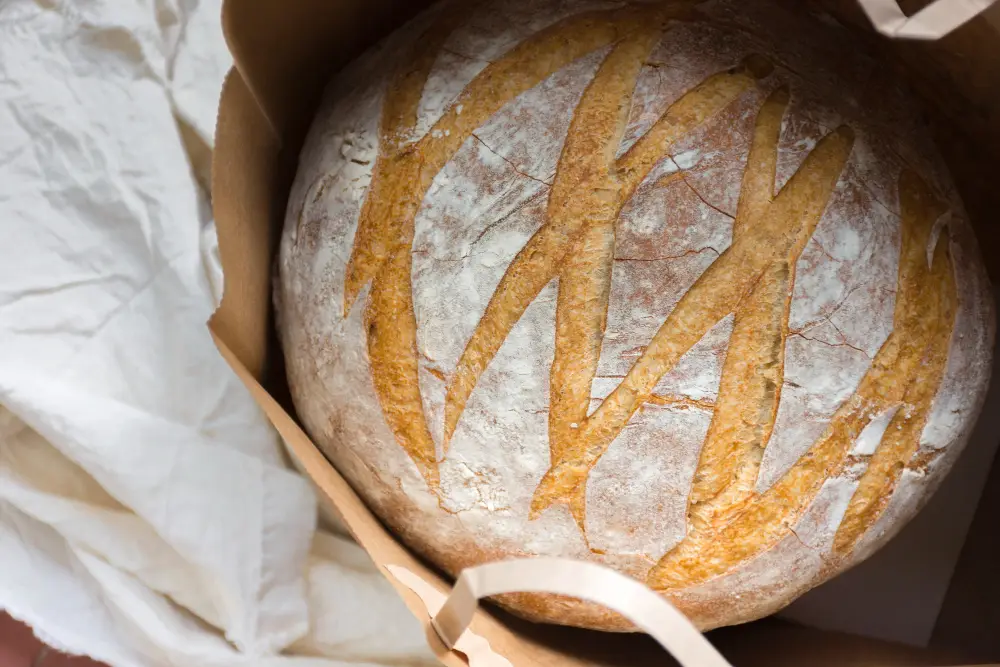
A single, confident cut along the top of the loaf is the most effective approach. The angle of the blade, the depth of the cut, and the decisiveness of the stroke all affect how the loaf opens. A hesitant or shallow score will seal over in the oven's heat before the loaf can open up. For a full breakdown of patterns, tools, and technique, see Scoring Sourdough: Patterns, Tools, and Technique.
Baking in Two Phases
Sourdough baking happens in two distinct phases:
Phase one — with lid: The loaf bakes covered for the first part of baking. Steam released from the dough's surface keeps the crust soft and extensible during this window, allowing the loaf to fully spring upward and open along the score before the crust sets. This is where the drama happens.
Phase two — without lid: The lid comes off and the loaf bakes uncovered until the crust develops deep colour. A properly baked sourdough is darker than most beginners expect — rich, deep brown, almost mahogany. Pale bread is underbaked. The caramelisation happening on the crust is where the complex, slightly bitter-sweet exterior flavour comes from.
If you have a probe thermometer, a fully baked sourdough will read close to 99°C internally.
Cooling
Transfer the baked loaf to a wire rack and leave it for at least one hour before cutting — ideally two. The crumb is still setting as the loaf cools. Cutting too early releases the trapped steam and results in a gummy interior that never recovers. The wait is genuinely the hardest part.
Assessing Your Bake
Once you cut into the loaf, take a moment to evaluate the result. This is how you improve.
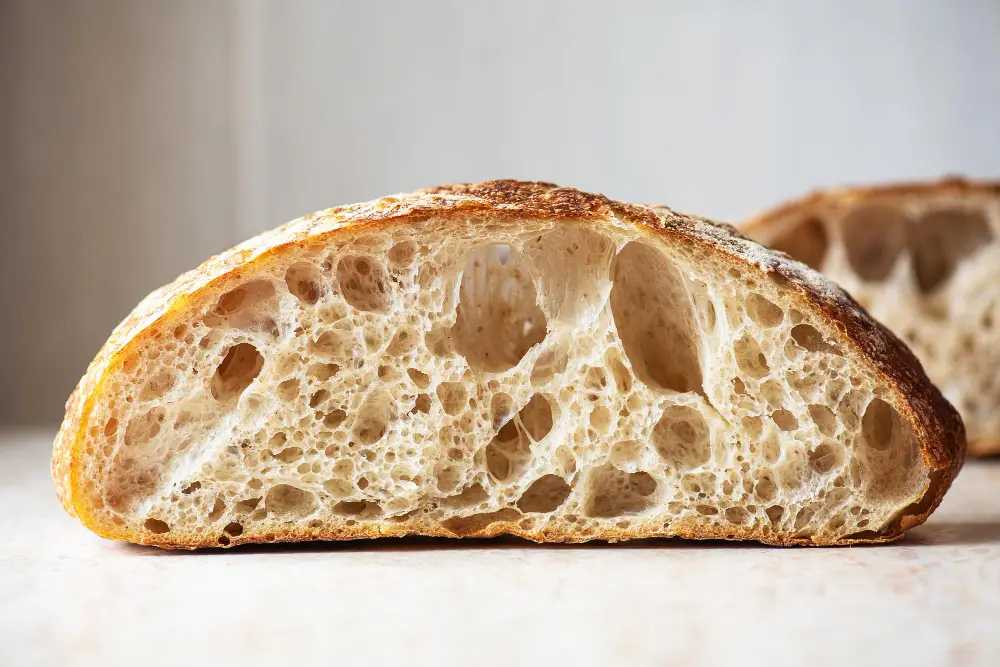
Crumb: Are the holes reasonably even and open, or dense and tight? Dense crumb usually points to under-fermentation or insufficient oven spring. For a deeper dive into getting a more open interior, read How to Get an Open Crumb in Sourdough.
Crust: Is it shattering when you cut it? Good. Is it soft and leathery? The bake probably needed longer in phase two, or the oven temperature was too low.
Shape: Did it spread sideways rather than rise upward? That is a shaping tension issue — the dough was not tight enough before it went into the banneton.
Flavour: Too sour? Not sour enough? Both are adjustable through fermentation time and temperature — this is covered in detail in our Sourdough Troubleshooting Guide.
No loaf is a failure. Every loaf teaches you something.
Troubleshooting the Most Common Problems
My loaf did not rise in the oven
This almost always comes down to one of three things: the starter was not active enough when mixed in, the dough was over-fermented during bulk (so the yeast had exhausted itself before baking), or the Dutch oven was not hot enough. Check your starter activity before mixing — it should be at or near peak, visibly bubbly, and roughly doubled in size since its last feed.
The crust is thick and tough, not crisp
Thick, tough crust usually means there was insufficient steam during phase one. This can happen if the Dutch oven was not fully preheated or the lid did not seal tightly. Make sure the pot is screaming hot before the dough goes in.
The inside is gummy
Gummy crumb is almost always a sign of cutting the loaf too early. Leave it to cool for at least an hour before slicing. If the crumb is consistently gummy even after proper cooling, the loaf may have been under-baked — extend phase two by five minutes and aim for a darker crust.
The loaf is very dense
Dense loaves are the most common complaint, and the most common cause is under-fermentation during bulk. Read Why Is My Sourdough So Dense? for a full breakdown of causes and fixes.
The dough is too sticky to shape
High-hydration sourdough dough is naturally stickier than commercial yeast dough. Using wet hands during bulk fermentation, working with cold dough from the fridge during shaping, and using a metal bench scraper for handling makes a significant difference. See How to Fix Sourdough That's Sticky and Hard to Shape for practical solutions.
Understanding Hydration
Hydration — the ratio of water to flour in a dough — is one of the most important variables in sourdough. Higher hydration produces a more open crumb and better oven spring, but makes the dough significantly stickier and harder to handle. Lower hydration is easier to work with but tends to produce a tighter crumb.
70% hydration is widely considered the sweet spot for a beginner-friendly classic sourdough — wet enough for a good result, but not so wet that shaping becomes a battle. As you become more comfortable handling dough, experimenting with higher hydration levels is a natural progression.
For a thorough explanation of what hydration percentages mean and how they affect your results, see Understanding Hydration in Sourdough.
Temperature and Fermentation: The Most Important Variable
More than any other factor, temperature controls fermentation speed. The same dough, with the same starter, will behave completely differently at 18°C versus 26°C.
According to research on sourdough fermentation kinetics, the optimal temperature range for balanced wild yeast and lactic acid bacteria activity is broadly 24–28°C. Below this range, fermentation slows and lactic acid production dominates. Above it, fermentation accelerates and the acidity profile shifts.
The most common mistake in warm kitchens is over-fermented dough — a bulk fermentation window that worked reliably in winter becomes far too long once summer arrives. Learning to read your dough rather than relying on fixed times is essential, and it is a skill that develops quickly with practice.
Variations to Try Once You Have the Basics
Once you have made a classic sourdough loaf a few times and feel comfortable with the process, here are natural ways to develop your baking:
Increase the Wholemeal Percentage
Swapping a larger proportion of white flour for wholemeal makes the dough slightly more extensible and speeds up fermentation, but produces noticeably richer, nuttier flavour.
Add Seeds or Inclusions
Toasted sesame seeds, sunflower seeds, walnuts, or olives can be folded into the dough during bulk fermentation. Use your hands to distribute them evenly before proceeding as normal.
Experiment with Scoring
Once you have the basic ear score mastered, try a box score, a leaf pattern, or a simple cross-hatch. Decorative scoring is as much art as science — you will find a full guide at Scoring Sourdough: Patterns, Tools, and Technique.
How to Store Your Sourdough
Sourdough keeps better than commercial bread thanks to the organic acids produced during fermentation, which naturally inhibit mould growth. Stored correctly, a loaf will stay fresh for three to five days.
Best method: Store the cut loaf cut-side down on a wooden chopping board, uncovered, at room temperature. The cut surface protects the crumb from drying out while leaving the crust exposed keeps it from going soft.
Avoid plastic bags. They trap moisture against the crust, turning it soft within hours. If you need to cover it, use a cotton bread bag or a clean tea towel.
Freezing: Sourdough freezes extremely well. Slice the whole loaf, wrap slices individually, and freeze. Toast directly from frozen — it comes out tasting freshly baked.
Want to Learn This in Person?
Reading about sourdough is one thing. Doing it with someone guiding you through every step — in real time, in a real kitchen — is something else entirely.
At The Sourdough Code, our Classic Sourdough Workshop takes you through this exact process over three hands-on hours. You will mix, ferment, shape, and score your own loaf, go home with it to bake, and leave with the knowledge and confidence to keep baking independently.
If you are not sure which workshop suits you best, our Classic vs Rye vs Gluten-Free: Which Workshop Is Right for You? comparison guide breaks it all down.
Or jump straight to What to Expect at a Sourdough Bread-Making Workshop to find out what the day looks like and how to book.
Frequently Asked Questions
Can I use plain flour instead of bread flour?
Plain flour has a lower protein content than strong bread flour — typically around 9–10% versus 12–14%. Lower protein means less gluten, which means less structure. Your loaf will likely be denser and spread more during baking. Bread flour is worth using for this recipe.
Can I skip the autolyse?
Yes. The autolyse is recommended but not essential. If you skip it, the dough will require more work during stretch and fold sets to develop the same level of strength. Try both approaches and see what you prefer.
What if I cannot do an overnight cold proof?
You can bake same-day. After final shaping, leave the dough at room temperature until it has proofed sufficiently, then bake. The loaf will be more difficult to score cleanly and will likely have less developed flavour, but it will still bake. The margin between properly proofed and over-proofed is much narrower at room temperature, so watch it carefully.
My starter floats — does that mean it is ready?
The float test is a popular indicator of readiness, but not perfectly reliable. A better indicator is observing that your starter has at least doubled since its last feeding, shows plenty of bubbles throughout, has a domed top, and smells yeasty and slightly tangy. For a full guide, see How to Know When Your Sourdough Starter Is Ready to Bake With.
How do I know if my dough is over-proofed?
Over-proofed dough feels airy and fragile. When you gently poke it, the indent springs back very slowly or not at all. When you tip it out for scoring, it may flatten and spread rather than holding its shape. Prevention is the best cure: keep a close eye on your dough during bulk fermentation, especially in warm kitchens.
Can I make this without a Dutch oven?
Yes, though results will differ. You need to create steam another way. Options include baking on a preheated stone or steel with a tray of boiling water on the shelf below, or covering the loaf with a large metal bowl for the first part of baking. For a full comparison of methods, read Baking Steel vs Dutch Oven for Sourdough.
Have a question about this recipe or want to share how your loaf turned out? We read every comment.