

What to Expect at a Sourdough Bread-Making Workshop
There is something quietly magical about pulling a golden loaf of sourdough from the oven. The crackling crust. The warm, tangy aroma that fills the room. The moment you cut through the first slice and see that open, chewy crumb stretching between your fingers.
If you have ever wanted to create that yourself — from scratch, with your own hands — a sourdough bread-making workshop is the single fastest way to make it happen.
But if you have never attended one before, you probably have questions. What exactly goes on during those few hours? Is it hands-on or mostly watching someone else bake? Do you need any experience? What do you actually walk away with?
This guide answers all of that and more. By the time you finish reading, you will know exactly what to expect at a sourdough workshop, why so many people describe it as one of the most rewarding experiences they have had in the kitchen, and how to choose the right class for you.
What Is a Sourdough Bread-Making Workshop?
A sourdough bread-making workshop is a structured, hands-on class where you learn how to make sourdough bread from start to finish. Unlike watching a YouTube video or following a recipe alone at home, a workshop puts you in the same room as an experienced baker who can guide you, answer your questions in real time, and catch mistakes before they ruin your loaf.
At The Sourdough Code, our workshop runs for three hours. That is long enough to cover every meaningful stage of the process — from understanding your starter to shaping dough to a baking demonstration — but short enough to fit into a weekend afternoon.
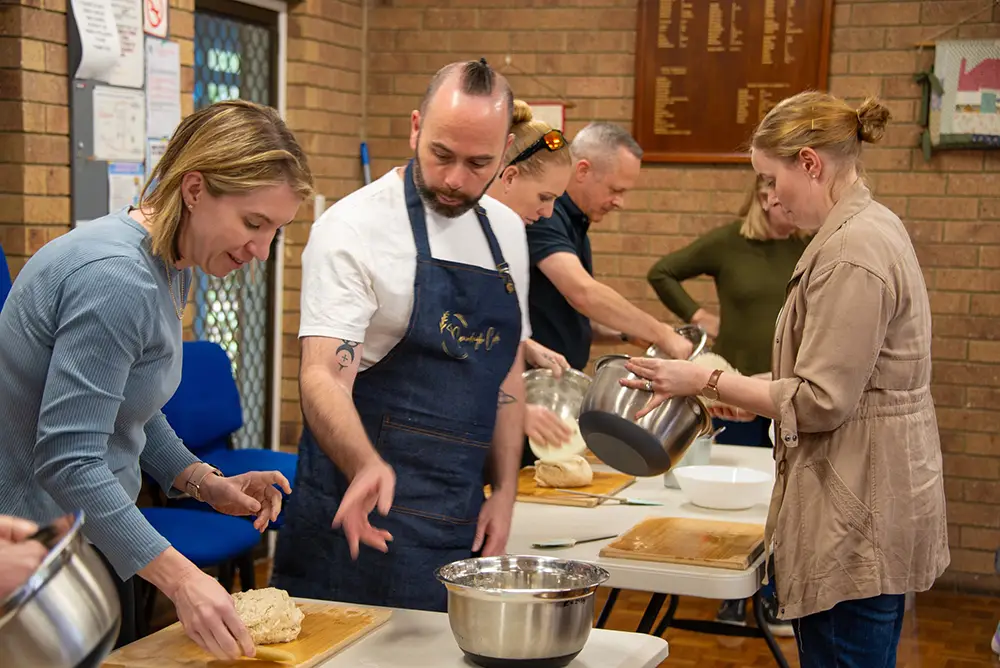
The workshop is not a lecture. You will not sit in a chair taking notes while someone talks at you from the front of the room. You will have your hands in dough. You will feel what properly developed gluten actually feels like. You will learn how to read your dough rather than just following a clock, and you will leave with the skills and the starter to keep baking long after the class ends.
Who Is a Sourdough Workshop For?
One of the most common things people say before booking is: "I'm probably not the right level for this."
They are usually wrong.
Sourdough workshops are designed to meet you exactly where you are. The vast majority of people who attend have never made sourdough before. Many have never baked bread of any kind. Some are experienced home bakers who have been frustrated by failed attempts at sourdough and want to finally understand what they have been doing wrong.
All of those people belong in the same room, because sourdough is one of those crafts where hands-on teaching levels the playing field quickly. A concept that takes three paragraphs to explain in a recipe takes about thirty seconds to demonstrate in person.
You should consider booking a workshop if:
- You have always wanted to bake sourdough but do not know where to start
- You have tried making sourdough at home and keep running into the same problems
- You want to understand why the process works, not just follow steps blindly
- You are looking for a creative, practical skill you can use for the rest of your life
- You want a meaningful gift experience for yourself or someone you love
You do not need any prior baking experience. You do not need your own equipment. You do not need to have read anything about sourdough beforehand — though if you want to get a head start, our Complete Beginner's Guide to Sourdough Bread is a great place to begin.
The Three-Hour Workshop: A Stage-by-Stage Breakdown
Stage 1: The Sourdough Starter — Understanding the Heart of the Process
Every sourdough loaf begins with a starter: a live culture of wild yeast and beneficial bacteria that ferments the dough and gives sourdough its distinctive flavour and texture. If you have never worked with a starter before, the concept can sound intimidating. By the end of the first stage of the workshop, it will not be.
Your instructor will explain what a sourdough starter actually is — a simple mixture of flour and water that has been colonised by wild yeast and lactobacillus bacteria — and why it behaves so differently from commercial yeast. You will learn how fermentation works at a basic level, including why temperature matters, what feeding schedules look like, and what signs tell you a starter is healthy and ready to use.
You will get to see, smell, and touch active starter at different stages of its feeding cycle. This is genuinely one of the most useful parts of the workshop, because starter health is the number one reason home bakers struggle. Being able to recognise an active, peaked starter by sight and smell — rather than guessing — is a skill that changes your results immediately.
At the end of the workshop, you will take home your very own starter. This is not a symbolic gesture. It is a living culture that, with basic care, you can keep alive and bake with for years — even decades. Some bakers pass their starters down through generations.
If you want to dive deeper into starter maintenance between sessions, our guide on maintaining a sourdough starter covers everything from fridge storage to reviving a neglected culture.
Stage 2: Ingredients and Dough — Building the Foundation
Once you understand the starter, the workshop moves into the dough itself. This stage covers ingredients, mixing, and hydration — three areas where beginners are most likely to go wrong.
Flour
Not all flours behave the same way in sourdough. The protein content of your flour directly affects gluten development, which in turn affects the structure, texture, and rise of your loaf. Your instructor will walk you through the most common choices — strong bread flour, whole wheat, and others — and explain what each one brings to the dough. You will understand why the flour you choose matters more than the brand on the bag.
Water
Water quality is one of those topics that sounds fussy but has a genuinely practical impact. Chlorine and chloramine in tap water can inhibit the very bacteria that make sourdough work. Your instructor will explain simple ways to manage this — most of which require no special equipment at all.
Salt
Salt does more than season bread. It controls fermentation speed, strengthens gluten structure, and affects flavour complexity. Understanding its role means you stop adding it on autopilot and start using it intentionally.
Hydration
Hydration — the ratio of water to flour in a dough — is one of the most important variables in sourdough baking and one of the most misunderstood. A 70% hydration dough handles very differently from an 80% dough. Your instructor will explain what the percentages mean in practice and how hydration changes both the texture of the crumb and the difficulty of working with the dough.
This is especially useful for beginners, because many online recipes call for high-hydration doughs that are genuinely hard to handle without experience. Knowing how to adjust hydration to suit your skill level — and your flour — is a practical skill you can use from the very first bake at home.
For a deeper look at this topic, our article on understanding hydration in sourdough breaks down the numbers with a simple reference chart.
Stage 3: Folding the Dough — Learning to Feel the Process
This is the stage that surprises people the most.
Most bakers assume that bread-making is about precise measurements and strict timing. And while those things matter, sourdough has an additional layer: it rewards bakers who learn to feel the dough, not just follow a recipe.
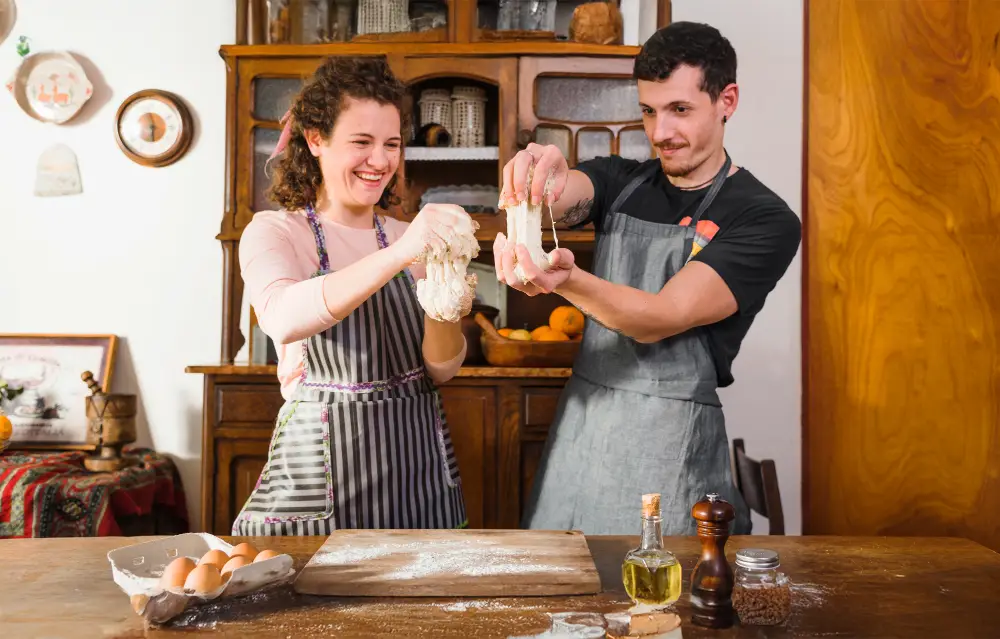
During bulk fermentation — the long period after mixing when the dough develops flavour and structure — you perform a series of stretch-and-fold sequences rather than traditional kneading. Each fold builds gluten strength, traps gas produced by fermentation, and develops the open, airy crumb that makes great sourdough so satisfying to eat.
Your instructor will demonstrate each fold technique and then have you do it yourself. You will feel what it means for dough to have tension. You will notice the difference between dough that has had enough folds and dough that needs more work. You will understand why a well-folded dough feels almost silky and holds its shape during the later stages.
This is one of those skills that is almost impossible to learn from a written recipe alone. Feeling it in your hands for the first time — and having someone there to confirm that yes, that is exactly right — is worth the entire workshop fee on its own.
The science behind what is happening during this stage is fascinating too. Research from the American Chemical Society shows that the long fermentation process breaks down complex carbohydrates and produces organic acids that give sourdough its distinctive tang and make it more digestible than conventional bread.
Stage 4: Shaping and Proofing — The Finishing Touches
Once bulk fermentation is complete, it is time to shape the dough. This is where your loaf starts to look like a loaf.
Shaping sourdough properly is more than just rolling the dough into a ball. Good shaping creates surface tension that helps the bread hold its structure during proofing and gives it the strength to spring up properly in the oven. Poor shaping leads to flat loaves, dense crumbs, and that crushing disappointment when you cut into a loaf and find a gummy interior.
Your instructor will walk you through the two most common shapes — the boule (round) and the batard (oval) — demonstrating the hand movements and explaining what you are trying to achieve at each step. You will then shape your own dough and get feedback in real time.
After shaping, the dough goes into a proofing basket (called a banneton) for its final rise. This stage is about developing flavour, building gas structure, and preparing the dough for the extreme heat of the oven. Your instructor will explain the difference between under-proofed and over-proofed dough, how to use the poke test to check readiness, and why many bakers prefer a cold retard — a slow overnight proof in the fridge — for better flavour and more flexible timing.
Stage 5: Baking — Getting It Across the Finishing Line
Baking sourdough is not simply a matter of setting an oven temperature and waiting. The first stage of baking — when the dough experiences a rapid rise called oven spring — requires a burst of steam to keep the crust soft long enough for the bread to expand fully. Without steam, the crust sets too quickly and restricts the rise, producing a tight, dense loaf.
Professional bakers use steam injection ovens. At home, the most effective solution is a Dutch oven (a heavy, lidded pot) that traps steam released by the dough itself during the early minutes of baking.
Your instructor will demonstrate the full baking process — including how to score the dough (the pattern of cuts made with a sharp blade immediately before it goes into the oven), why scoring is essential for controlled expansion, and how to manage oven temperature through the two stages of baking: the covered phase for steam and rise, and the uncovered phase for crust colour and crunch.
You will watch the loaf transform in real time and learn to read the visual cues that tell you when bread is perfectly baked — deep golden-brown colour, a hollow sound when tapped on the base, and an internal temperature of around 95–98°C.
Stage 6: Tips, Troubleshooting, and Q&A
The final section of the workshop is dedicated to troubleshooting and questions — and it is often where the most useful learning happens.
Your instructor will cover the most common sourdough problems and how to fix them:
- Dense crumb — usually caused by under-fermentation, a weak starter, or poor shaping
- No rise — most often a starter issue, but also linked to temperature and over-proofing
- Gummy interior — cutting too early, under-baking, or too-high hydration for the flour
- Too sour or not sour enough — controlled through fermentation time, temperature, and flour choice
- Dough that won't hold its shape — a shaping tension problem or a hydration issue
You will also have open time to ask about your own specific struggles. If you have been baking at home and hitting the same wall every time, this is your chance to get a direct, experience-based answer. Our instructors have worked with hundreds of students and have seen — and solved — virtually every sourdough problem there is.
For a full reference guide on diagnosing and fixing problems, our sourdough troubleshooting guide goes deep on every symptom you are likely to encounter at home.
What You Take Home
At the end of the three-hour workshop, you will leave with more than just knowledge.
Your sourdough starter. A live, active culture that is ready to bake with. This is arguably the most valuable thing you will take home, because building a healthy starter from scratch takes one to two weeks and a lot of patience. Yours will be ready to use as soon as you get home.
The skills to use it. Watching videos and reading recipes is one thing. Having physically felt and worked with dough — and having been corrected and guided through each step — is something else entirely. The muscle memory you develop in a three-hour workshop is worth weeks of solo trial and error.
Confidence. This is not a small thing. One of the most consistent pieces of feedback we receive from students is that they came in nervous and left feeling like they could actually do this. Sourdough has an undeserved reputation for being difficult. It is not difficult — it is just different. Once you understand how it works, it becomes intuitive.
Troubleshooting instincts. You will leave knowing not just how to bake sourdough but why each step matters. That understanding is what allows you to diagnose problems and fix them rather than giving up when a loaf does not go to plan.
Ongoing support. The learning does not stop when the class ends. Students at The Sourdough Code have access to guidance and support as they start baking at home, so if you hit a problem in your first few bakes, you are not on your own.
Why Learn Sourdough? The Benefits Go Further Than You Might Think
People come to sourdough workshops for all sorts of reasons, and they often discover benefits they were not expecting. Here is a fuller picture of what sourdough brings to your life once you know how to make it.
Health and Nutrition
Sourdough fermentation does something commercially produced bread cannot replicate: it breaks down a significant portion of the gluten and phytic acid in the flour through long fermentation. Research published in the journal Food Microbiology has found that this process improves mineral bioavailability — meaning your body can absorb more of the iron, zinc, and magnesium present in the flour.
Sourdough also has a lower glycaemic index than standard white bread, meaning it produces a more gradual rise in blood sugar rather than a sharp spike. This is a meaningful difference for people managing energy levels, blood sugar, or appetite throughout the day.
The fermentation process also increases the presence of organic acids that create a more hospitable environment for beneficial gut bacteria, supporting digestive health. For people who find conventional bread difficult to digest, properly fermented sourdough is often far more comfortable — a topic we explore in depth in our article on whether sourdough is easier to digest.
Financial Benefits
A quality artisan sourdough loaf from a bakery can cost anywhere from $8 to $15 or more. Once you know how to bake sourdough at home, your ingredient costs drop to a fraction of that. A kilogram of strong bread flour costs roughly $2–4, and each loaf uses around 500 grams of flour. Even accounting for electricity, you are looking at a cost per loaf well under $3.
Buy flour in larger quantities and that cost drops further. Many experienced home bakers also find that keeping a starter running gives them a reason to use up discard — the portion of starter you remove during regular feedings — in everything from pancakes to crackers to pizza dough, reducing food waste across the board.
Some graduates of sourdough workshops find that their new skill turns into a small side income, selling loaves to friends, colleagues, or at local markets. It is not a path everyone takes, but it is a real possibility once you have the skills and the confidence.
Mental and Emotional Wellbeing
There is something deeply grounding about working with dough. The repetitive, tactile nature of mixing and folding has a meditative quality that many bakers describe as one of the best parts of the practice. Research into mindful food preparation suggests that engaging, hands-on cooking activities reduce stress and improve mood — sourdough baking fits that description perfectly.
Sourdough also teaches patience in a way that few hobbies do. The process cannot be rushed. You learn to work with time rather than against it, which has a way of spilling over into how you approach other things in your life.
Environmental Impact
Making your own sourdough bread means less packaging — no plastic bags, no cardboard sleeves, no unrecyclable seals. It means less food transport, because your bread travels from your kitchen to your table rather than from an industrial bakery to a distribution centre to a supermarket shelf. If you source your flour from local mills, the environmental footprint shrinks even further.
Cultural Connection
Sourdough is one of the oldest food preparation methods in human history. Archaeological evidence suggests that humans were baking leavened bread as far back as 14,000 years ago. When you maintain a starter and bake with it, you are participating in a practice that connects you to bakers across millennia and cultures. That is not nothing.
Which Workshop Is Right for You?
At The Sourdough Code, we offer three workshop formats, each designed around a different style of baking.
The Classic Sourdough Workshop is the one described throughout this article. It covers traditional white sourdough — the bread that most people picture when they think of sourdough. It is the best starting point for beginners and is also where experienced home bakers tend to refine their technique most effectively.
The Rye Sourdough Workshop goes deeper into the world of rye-based breads — darker, denser, more complex in flavour, and behaving quite differently from wheat-based doughs due to their unique starch and fibre composition. If you have always been drawn to the hearty, slightly sour flavour of Scandinavian and Eastern European rye breads, this is the workshop for you.
The Gluten-Free Sourdough Workshop is tailored specifically for bakers who are managing coeliac disease, a gluten intolerance, or who simply choose to bake without gluten. Gluten-free sourdough presents its own distinct challenges — different flour blends, different binding strategies, different hydration requirements — and this workshop addresses all of them directly.
Not sure which one to choose? Our guide to Classic vs Rye vs Gluten-Free: Which Sourdough Workshop Is Right for You walks through each option in detail, including who each workshop suits best and what you will have learned by the end.
Common Questions About Sourdough Workshops
Do I need any experience to attend?
No. Our workshops are designed to welcome complete beginners. The Classic Sourdough Workshop assumes no prior knowledge. If you have some baking background, that is helpful context, but it is absolutely not required.
How many people are in a workshop?
We keep our groups small. This is not a large cooking class where you spend most of the time watching from a distance. Small group sizes mean your instructor can work closely with every participant, give hands-on feedback, and make sure no one gets left behind.
What should I wear or bring?
Wear clothes you do not mind getting a little floury — aprons are provided, but sourdough has a way of finding gaps in any protection. You do not need to bring any ingredients or equipment. Everything is provided in the workshop.
Bringing a small notebook is useful if you like having a written record of tips and ratios to refer back to at home. Some students also bring a bag or container for their starter, though we provide packaging for it.
Can I really learn sourdough in three hours?
This is one of the most common questions we get — and we answer it honestly in our article Can You Really Learn Sourdough in 3 Hours?
The short version: yes, you can learn enough in three hours to go home and bake a successful loaf. No, three hours is not long enough to make you an expert. What the workshop does is give you a solid foundation of understanding and technique, plus a live starter and the confidence to keep practising. The learning deepens every time you bake.
Most students bake their first loaf at home within a few days of the workshop and report feeling far more prepared than they expected. The combination of hands-on practice, real-time correction, and take-home starter makes a meaningful difference compared to learning entirely from written recipes.
Is the workshop suitable as a gift?
Absolutely. A sourdough workshop is one of those gifts that keeps giving — the recipient learns a skill they can use for life, takes home a starter, and has a genuinely enjoyable experience rather than just another object to find a place for.
It works especially well as a gift for home cooks, people who have expressed an interest in bread-making, parents whose children have grown up and are cooking for themselves for the first time, and anyone who has mentioned wanting to do something creative and hands-on. Our article on Sourdough as a Gift: Why a Workshop Makes the Perfect Present goes into more detail on how to give it and when.
What Students Say After Their First Workshop
The feedback we receive most consistently from students centres on two things: surprise and confidence.
Surprise, because sourdough turns out to be more approachable than they expected once someone explains the logic behind the process. And confidence, because having physically done the thing — having mixed, folded, shaped, and seen their dough develop through each stage — they believe for the first time that they can actually bake bread at home.
Students also frequently mention the tips they had not found in any recipe. The small adjustments — the way to check if bulk fermentation is complete, the trick for getting good surface tension when shaping, the visual cues that tell you your scoring is right before the bread even goes in the oven — are the things that separate a good bake from a frustrating one, and they are much easier to convey in person than in print.
For a sample of the kinds of insights students leave with, our article on [X] Things Our Students Wish They Knew Before Their First Bake captures some of the most valuable ones.
How to Get the Most Out of a Sourdough Workshop
Attending a workshop is the biggest step you can take towards baking great sourdough. But there are a few things you can do to make the experience even more valuable.
Read a little beforehand, but not too much. A basic understanding of what a sourdough starter is and what the main stages of the process look like will help you absorb the hands-on learning more quickly. Our Complete Beginner's Guide to Sourdough is the perfect preparation — it gives you context without overwhelming you before you have even touched any dough.
Ask questions freely. Your instructor has seen every problem, answered every question, and made every mistake themselves at some point. There are no questions that are too basic. The more you ask, the more you get out of the experience.
Take notes on the things that surprise you. Recipes are easy to find. The small, specific observations — the way the dough should feel at a particular stage, the smell of a healthy starter, the visual cue that tells you oven spring is done — are harder to find in writing and easy to forget once you leave the room.
Bake as soon as you get home. Do not let the starter sit in the fridge for three weeks before you use it. The longer you wait, the more the experience fades. Bake within a few days while the techniques are fresh in your muscle memory.
Do not expect perfection on the first loaf. Your first home bake after the workshop will probably be good. It will probably not be perfect. That is completely normal and entirely expected. Every loaf teaches you something. The goal of the workshop is not to produce a perfect loaf in three hours — it is to give you the foundation to produce consistently great bread over time.
The Sourdough Code: A Workshop Built Around Real Learning
At The Sourdough Code, we built our workshop around a single principle: that the best way to learn sourdough is to make it, in the company of experienced bakers who care about your progress.
We are passionate about bread in the truest sense of that word. Not just the eating of it — though that is wonderful — but the craft of it. The way a well-developed dough feels different from an under-mixed one. The sound of a crust that has baked properly. The satisfaction of a loaf that you built from four ingredients and time.
Our instructors blend what they know about the science of fermentation with the practical, intuitive knowledge that only comes from baking hundreds of loaves. The result is a workshop that teaches you both the why and the how — so that when something goes wrong at home (and sometimes something will), you have the understanding to fix it rather than the frustration of not knowing where to start.
We keep group sizes small, we make the environment relaxed and enjoyable, and we give every student the kind of attention that actually makes a difference to the quality of learning.
If you have been thinking about learning sourdough, there is no better time to start. Spaces fill quickly, particularly at weekends and during the gifting seasons of the year.
Ready to Rise to the Occasion?
A sourdough workshop is not just a cooking class. It is a few hours that give you a skill, a habit, and a connection to a tradition that has nourished people for thousands of years.
You will leave with your own starter, a clear understanding of the process, and the confidence to bake at home from that day forward. You will know why your bread does what it does — and what to do about it when it does not do what you want.
Whether you are booking for yourself, as a gift, or as a way to finally crack the sourdough code after months of frustration at home, the workshop will be worth your time.
Spaces are limited and they fill up quickly. Click the button below to secure your spot, and we will see you in the kitchen.
[Register Now — Book Your Sourdough Workshop]
Want to keep reading? Here is what to explore next:
- Classic vs Rye vs Gluten-Free: Which Sourdough Workshop Is Right for You?
- Can You Really Learn Sourdough in 3 Hours?
- [X] Things Our Students Wish They Knew Before Their First Bake
- Sourdough as a Gift: Why a Workshop Makes the Perfect Present
- The Complete Beginner's Guide to Sourdough Bread
The Sourdough Code runs hands-on sourdough bread-making workshops for all skill levels. Small groups, expert instructors, and a live starter to take home — everything you need to start baking great sourdough.