
Baking Steel vs Dutch Oven for Sourdough
You've made your starter, nailed your bulk fermentation, and shaped a beautiful loaf. Now you face the final question: how do you actually bake it?
Two pieces of equipment dominate the home sourdough world — the Dutch oven and the baking steel. Both can produce outstanding results. But they work in very different ways, and one is likely to suit you better than the other depending on how you bake.
This guide breaks down exactly how each method works, the pros and cons of both, and a simple way to decide which one to use. We'll also cover the two main Dutch oven approaches — the pre-heated method and the cold start method — so you know all your options before you spend a cent.
Why the Baking Environment Matters So Much
Before comparing the two tools, it's worth understanding what you're trying to achieve inside the oven.
Sourdough needs two things to bake well:
Steam in the early phase. In the first 15–20 minutes, steam keeps the crust soft enough to expand. Without it, the crust sets too quickly and the loaf can't rise fully. This is what creates good oven spring — that dramatic final lift you see in a well-baked loaf.
Dry, intense heat for the second phase. Once the loaf has sprung, you want a dry, high-temperature environment to set the crust and develop colour and flavour.
A standard home oven delivers neither of these well on its own. The Dutch oven and baking steel are two very different solutions to the same problem. You can read more about the role of steam in our guide to Dutch oven sourdough baking.
The Dutch Oven: Trapped Steam, Consistent Results
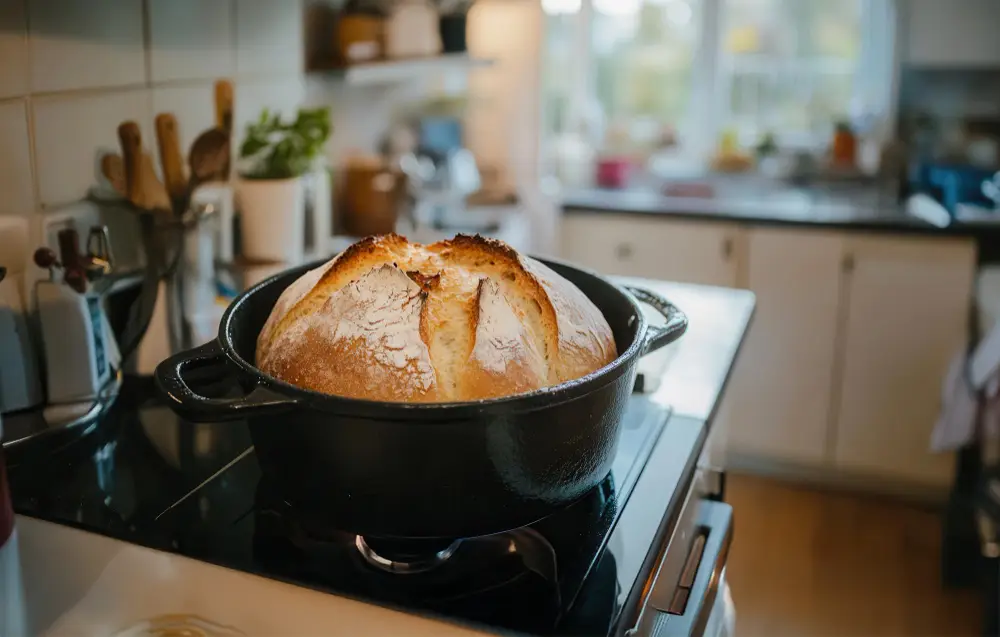
A Dutch oven is a heavy, lidded pot — typically cast iron — that you bake your sourdough inside. It's one of the most popular tools for home bakers and for good reason.
How it works
When you place your shaped dough into a hot Dutch oven and put the lid on, you trap the moisture that evaporates from the dough itself. That trapped steam does the job of a professional steam-injection oven — it keeps the surface of the loaf moist and elastic during the critical first phase of baking.
After 20 minutes or so, you remove the lid. The steam escapes, and the crust rapidly dries out and browns.
Pre-heated Dutch oven method
This is the traditional approach and still the most widely used.
You place your empty Dutch oven in the oven and preheat both together, usually to around 230–250°C (450–480°F). Once at temperature, you carefully lower your cold, proofed dough directly into the screaming-hot pot.
The advantages: The burst of heat from the hot pot gives immediate, powerful oven spring. The contrast between cold dough and a fiercely hot surface encourages the loaf to rise dramatically before the crust sets.
The disadvantage: Handling a heavy cast iron pot that's been sitting at 250°C is genuinely dangerous. Lowering dough into it requires care and confidence. It's easy to burn yourself, and it can be intimidating for new bakers.
Cold start Dutch oven method
The cold start method has become popular in recent years, and it's particularly good for beginners.
Instead of preheating the Dutch oven, you place your shaped and proofed dough into a room-temperature pot, put the lid on, and then put the whole thing into a cold oven. You then turn the oven on and let everything heat up together.
The advantages: It's much safer and easier to handle. You don't need to wrestle with a red-hot pot. The gentler, more gradual heat rise can also be forgiving on slightly over-proofed or fragile doughs.
The disadvantage: The initial oven spring is slightly less dramatic than with the pre-heated method. You may get a marginally less open crumb, though the difference is often small for a standard home loaf.
The cold start is a great entry point. As your confidence grows, you can experiment with the pre-heated method to see whether it makes a noticeable difference for your particular loaf and oven.
Pros and cons of the Dutch oven
| ✅ Excellent steam retention | ❌ Heavy and can be difficult to handle hot |
| ✅ Consistent, repeatable results | ❌ Limits loaf size and shape to the pot |
| ✅ Works in any oven | ❌ Can't bake a batard in a round pot |
| ✅ Cold start option for beginners | ❌ Good quality cast iron has a higher upfront cost |
| ✅ No need to modify your oven |
The Baking Steel: Intense Bottom Heat, Open Possibilities
A baking steel is a thick, flat slab of steel — usually around 6mm–10mm thick — that you preheat on your oven rack. It works on the same principle as a baking stone, but conducts heat far more efficiently.
How it works
Steel conducts heat roughly 18 times better than ceramic or stone. When your cold dough hits a fully preheated steel, it receives an immediate, intense blast of bottom heat. This drives rapid oven spring from the base of the loaf.
But steel alone doesn't solve the steam problem. To make it work for sourdough, you need to introduce steam into the oven by another method — typically by placing a metal tray of boiling water on the rack below, or by using an inverted roasting tray or large bowl as a cover over the dough for the first phase of baking.
Pros and cons of the baking steel
| ✅ Outstanding bottom heat for oven spring | ❌ Requires a separate steam solution |
| ✅ Can bake any shape or size of loaf | ❌ Heavier and more expensive than a stone |
| ✅ Multi-purpose (also great for pizza) | ❌ Slightly more set-up and variables to manage |
| ✅ More durable than a baking stone | ❌ Less forgiving if your steam method fails |
| ✅ Excellent for batards and larger loaves |
Baking Steel vs Dutch Oven: Head-to-Head
Steam control
The Dutch oven wins here, and it's not close. Trapping steam inside the pot is a simple, reliable, foolproof method. With a baking steel, your steam method can vary — a tray of water may not produce enough steam in some ovens, and you need to get the timing right when removing your improvised cover.
Winner: Dutch oven
Oven spring
Both methods can produce excellent oven spring. The pre-heated Dutch oven method delivers a fierce initial heat that rivals or beats a baking steel for most home loaves. The baking steel can produce a taller ear and more dramatic rise in some cases, particularly for experienced bakers who have dialled in their steam method.
Winner: Draw (pre-heated Dutch oven edges it for beginners)
Loaf shape and size
This is the baking steel's biggest advantage. A Dutch oven limits you to the shape and size of your pot. A 26cm round Dutch oven means round loaves up to a certain size. If you want to bake a long batard, a large miche, or a scored oval loaf, you'll struggle.
With a baking steel, the baking surface is flat and open. You can bake any shape, any size, without restriction.
Winner: Baking steel
Ease of use
The Dutch oven is simpler to operate, especially with the cold start method. You don't need to think about steam generation as a separate step. Everything happens inside one vessel.
Winner: Dutch oven
Versatility
A baking steel is excellent for pizza, flatbreads, and pastry, as well as sourdough. A Dutch oven is brilliant for sourdough and also for braising, soups, and stews. Both earn their place in a kitchen. If your only goal is great sourdough, the Dutch oven is the more direct path.
Winner: Draw
Cost
A quality enamelled cast iron Dutch oven (such as a Le Creuset or a more affordable Lodge) typically costs between £50–£250 depending on brand and size. A good baking steel sits in the £70–£120 range. A basic cast iron Dutch oven from a budget brand can be found for under £40, making it the more accessible starting point.
Winner: Dutch oven (marginally)
Which One Should You Buy?
Choose a Dutch oven if:
- You're new to sourdough baking
- You want the simplest, most reliable setup
- You mostly bake round boules
- You want one pot that does multiple jobs in the kitchen
- You're not confident managing multiple variables at once
Choose a baking steel if:
- You want to bake batards, large loaves, or unusual shapes
- You already have a reliable steam method (or want to develop one)
- You also want to bake pizzas or flatbreads
- You're an experienced baker looking to fine-tune results
- You're baking large quantities regularly
Can you use both?
Yes — and many serious sourdough bakers do. Some use a Dutch oven for standard round loaves and a baking steel with a cover for larger or differently shaped loaves. But if you're just getting started, pick one and get confident with it. You don't need both on day one.
What About a Baking Stone?
If you're comparing options, you'll also come across baking stones — typically made from cordierite or ceramic. They work on the same principle as baking steel but conduct heat less effectively, take longer to preheat, and can crack with sudden temperature changes.
For sourdough specifically, a baking steel outperforms a baking stone in almost every way. The steel heats faster, retains heat better, and won't crack. If you're choosing between stone and steel, go with steel.
A Note on Oven Temperature
Regardless of which method you use, oven temperature matters enormously. Most sourdough bakes call for a very hot oven — 230–250°C (450–480°F). A Dutch oven or baking steel only performs well if your oven is genuinely reaching the temperature you've set.
Many home ovens run cooler than their dial suggests. If your results are consistently disappointing — poor spring, pale crust, gummy crumb — it's worth checking your oven's actual temperature with an oven thermometer before blaming your technique or equipment.
Getting Started With Your Equipment
Once you've chosen your baking method, it's time to put everything together. Our complete guide to sourdough ingredients and equipment covers everything you'll need from day one — including what's essential and what you can skip.
If you're still building your flour knowledge to go alongside your new baking setup, our guide to the best flour for sourdough bread will help you make the right choice at the flour bag stage too.
And if you want to understand why steam makes such a dramatic difference to your finished loaf, we go deep on the science in our Dutch oven sourdough baking guide.
Learn It All in a Single Afternoon
Equipment is only part of the picture. The real breakthrough in sourdough baking usually comes from watching and doing — understanding what well-fermented dough looks like, how to shape it under the right tension, and how to read the bake as it's happening.
Our sourdough workshops cover the full process hands-on, in a small group setting, over three hours. You'll bake a real loaf, take it home, and leave with the understanding and confidence to repeat it. Find out which workshop is right for you — classic, rye, or gluten-free.
Part of our Sourdough Ingredients and Equipment series. Also see: Do You Need a Banneton? and Does Water Quality Matter?