
How to Know When Your Sourdough Starter Is Ready to Bake With
One of the most common questions new bakers ask is: how do I know when my sourdough starter is ready? Bake too early and your loaf will be flat and dense. Wait too long and you've missed the window entirely.
The good news is that your starter gives you clear signals — once you know what to look for. This guide walks you through every reliable sign of a healthy, active starter, explains the float test (and its limitations), and helps you avoid the false positives that trip up so many beginners.
If you're still building your starter from scratch, head over to our guide on how to make a sourdough starter from scratch before reading on. And if any of the terms here are unfamiliar, our sourdough glossary has you covered.
What Does "Ready" Actually Mean?
A sourdough starter is a living culture of wild yeast and bacteria. When you feed it — mixing in fresh flour and water — the microorganisms eat the sugars in the flour and produce carbon dioxide gas and acids as by-products. This is sourdough fermentation.
"Ready to bake" means the starter is at or near its peak activity — the point where yeast production is highest and the culture is most powerful. Bake with it now and it will leaven your bread properly, create good oven spring, and give you the flavour you're after.
Peak activity follows a predictable cycle after each feed:
- Lag phase — the starter looks quiet. Yeast and bacteria are waking up and multiplying.
- Rise phase — bubbles appear, the starter grows in volume, and activity increases rapidly.
- Peak — maximum volume is reached. This is your baking window.
- Fall phase — the starter starts to collapse as food runs out. The culture becomes more acidic.
Your goal is to catch the starter at or just before peak. Miss it and you'll need to feed it again and wait.
The Most Reliable Signs Your Starter Is Ready
1. It Has Doubled in Size (or More)
The single most reliable sign is volume. After feeding, a healthy starter should roughly double in size — sometimes even triple — within 4–12 hours depending on the temperature in your kitchen.
Use a rubber band or a piece of tape to mark the level of your starter right after feeding. This makes it easy to track how much it's risen without guessing.
Tip: Pour your starter into a straight-sided jar (a mason jar works perfectly) so you can see the rise clearly. Tapered bowls make it hard to judge volume accurately.
2. A Dome Has Formed on Top
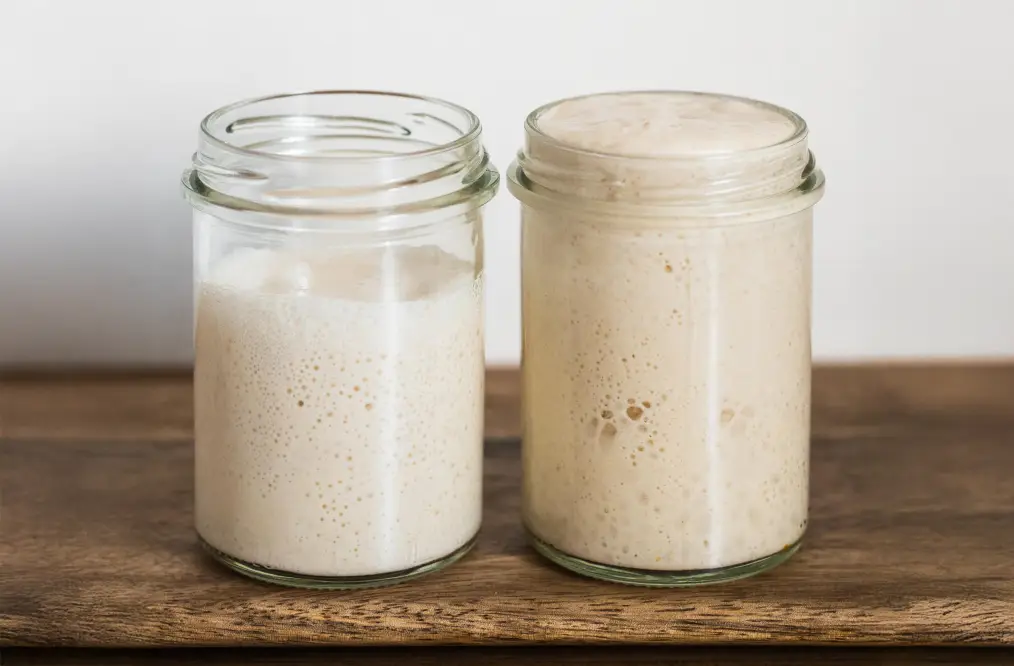
When your starter is at peak, its surface will be domed — slightly rounded and convex. This is a sign the gases are still trapped inside and activity is still strong.
Once the dome starts to flatten or the surface begins to look concave (sunken in the middle), the starter has passed its peak and is beginning to fall.
3. It's Full of Bubbles — Inside and Out
Look through the glass. A ready starter will have a web of bubbles throughout, not just on the surface. The bubbles near the edges of the jar will often be visible as a frothy, honeycomb-like structure.
On the surface, you may see larger bubbles popping and a foamy, slightly uneven texture. This is exactly what you want.
A starter with bubbles only on top — but looking dense or flat below — hasn't fully activated yet.
4. It Smells Pleasantly Sour and Yeasty
Smell is an underrated indicator. A starter at peak smells lightly tangy and slightly yeasty — similar to yoghurt or mild beer. Some bakers describe it as fruity or almost like fresh bread dough.
If your starter smells very sharp and acidic (like vinegar), it's likely past peak and over-fermented. If it smells unpleasant or like nail polish remover (acetone), it's hungry and needs a feed.
Learn more about how fermentation affects flavour in our guide to sourdough fermentation science.
5. It Has a Light, Airy Texture When Stirred
Give your starter a stir before using it. At peak, it should feel light and stretchy — not dense or paste-like. If you lift your spoon, the starter should stretch slightly before falling back, showing that gluten and gas structure are present.
The Float Test: Useful, But Not the Whole Story
The float test is one of the most widely shared sourdough tips online. Drop a small spoonful of starter into a glass of water — if it floats, it's ready.
The idea is sound: a starter full of gas bubbles should be light enough to float. And in many cases, it works well as a quick confirmation.
However, the float test has real limitations, and relying on it alone can lead you astray.
When the Float Test Works
- Your starter is at or near peak activity
- You're using a healthy, well-established starter (typically at least 1–2 weeks old)
- Your starter has a reasonably thick consistency (higher hydration starters may sink even when active)
When the Float Test Fails
False negatives are common. A starter that is genuinely active and ready to bake may still sink if:
- It's a high-hydration (runny) starter — the gas bubbles escape too quickly in water
- You're using whole wheat or rye flour, which produces a denser texture
- The starter was stirred or deflated before testing
False positives can also happen. A starter might float but still underperform if:
- It's actually past peak and the remaining gas is enough to float, but the yeast activity has dropped off
- The starter is young and producing gas inconsistently
Think of the float test as one piece of evidence, not the verdict. Use it alongside the visual and smell cues above for a more complete picture.
Timing: How Long Does It Take After Feeding?
There's no single answer — timing depends heavily on temperature, feeding ratio, and how established your starter is. As a general guide:
| Kitchen Temperature | Time to Peak After Feeding |
|---|---|
| 18–20°C (cool) | 10–14 hours |
| 21–24°C (room temp) | 5–8 hours |
| 25–28°C (warm) | 3–5 hours |
A warmer kitchen speeds up fermentation. A cooler kitchen slows it down. This is important to understand because a starter that takes 12 hours in winter may peak in 4 hours in summer — even if you're doing nothing differently.
If your starter consistently peaks faster than you can bake, try feeding it in the evening so it's ready in the morning. Or increase your feeding ratio (for example, 1:5:5 — one part starter to five parts flour and five parts water) to extend the time to peak.
For more on how temperature and timing interact, see our article on understanding hydration in sourdough.
How to Know It's NOT Ready
Sometimes it's just as important to recognise when your starter isn't ready as when it is. Here are the signs to watch for:
It Hasn't Risen Much Since Feeding
If your starter is only 20–30% larger than when you fed it, it hasn't reached peak. Give it more time, and check the temperature in your kitchen. If it consistently fails to rise well, it may need more frequent feeding or a change in flour.
The Surface Looks Flat or Sunken
A flat or concave surface means the starter has already peaked and is now falling. It's not ideal for baking, but not ruined either — just feed it again and wait for the next peak.
It Has a Layer of Liquid on Top
A greyish or dark liquid layer (called hooch) sitting on top of your starter means it's hungry and has been left too long without feeding. Pour it off and feed the starter. It will recover, but it isn't ready to bake with right now.
It's Young and Inconsistent
A starter that's less than 7–10 days old may show gas activity but still be too weak or unpredictable to leaven a full loaf of bread. Young starters can produce carbon dioxide without yet having the right balance of yeast and bacteria to create strong, consistent fermentation. Give it more time and more feeds before you bake. Research published by food microbiologists at Cornell University shows that the microbial community in a new starter takes at least one to two weeks to stabilise.
A Simple Checklist Before You Bake
Before you use your starter, run through this quick checklist:
- Fed within the last 4–12 hours (depending on your kitchen temperature)
- Has at least doubled in volume since feeding
- Surface is domed or slightly rounded
- Visible bubbles throughout the starter, not just on top
- Smells pleasantly sour and yeasty — not vinegary or like acetone
- Has a light, airy texture when stirred
- (Optional) Passes the float test as a final confirmation
If you can tick most of those boxes, you're ready to bake.
What About Long-Term Storage?
Once your starter is well established, you won't need to bake from it every day. Most home bakers keep their starter in the fridge between bakes, where fermentation slows dramatically. Before baking, you'll bring it back to room temperature and give it one or two feeds to wake it up and bring it back to peak activity.
Our full guide on sourdough starter maintenance covers everything you need to know about the long-term care of your culture.
Ready to Bake? Start With the Basics
Once your starter reliably doubles after feeding, holds a dome, and smells alive and active, you're ready to make your first loaf. Our complete beginner's guide to sourdough bread takes you through the full process from here — from mixing your dough to pulling a finished loaf from the oven.
And if you'd rather learn hands-on with expert guidance from the very start, our sourdough bread-making workshops cover starter health, baking technique, and everything in between in a single three-hour session. It's a great way to fast-track your confidence and go home with a loaf you've made yourself.