
Sourdough Ingredients and Equipment: Everything You Need to Get Started
There is a moment that happens to almost every new sourdough baker. You find a recipe you love, you get excited, and then you read the equipment list and feel your enthusiasm drain away. Dutch ovens. Bannetons. Bench scrapers. Lame blades. Baking scales. It can look like a very expensive hobby before you have baked a single loaf.
Here is the truth: you can make an excellent sourdough loaf with far less than most lists suggest. You also, eventually, will want a few specific tools that genuinely make a difference. Knowing which is which — essential versus optional, worthwhile upgrade versus overhyped gadget — is exactly what this guide is for.
We will cover every ingredient and every piece of equipment that comes up in sourdough baking. For each one, we will explain what it does, whether you really need it, and what to use instead if you do not have it. By the end, you will be able to walk into a kitchen shop (or skip one entirely) with complete confidence.
The Ingredients: Simple, But Worth Understanding
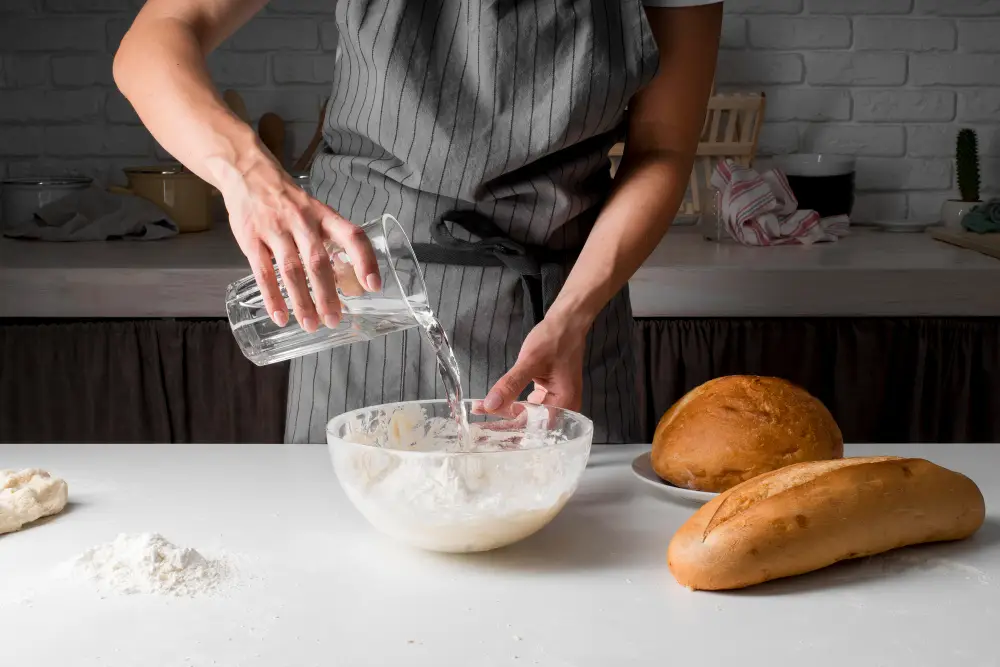
Sourdough uses four ingredients: flour, water, salt, and a live starter. That is it. No commercial yeast, no improvers, no additives. But the quality and characteristics of each one have a genuine effect on your results, and understanding them takes a lot of the guesswork out of early baking.
Flour: The Most Important Ingredient You Will Buy
Flour is where your bread begins and ends. More than any other variable — more than your technique, your schedule, or your equipment — flour determines what kind of loaf you can produce.
What to look for
Sourdough bread needs strong flour, meaning flour with a high protein content. Protein is what forms gluten, and gluten is the network of elastic strands that traps the gas produced by your starter's fermentation. Without enough gluten, your dough will not hold its structure and your loaf will be flat and dense.
For a standard white sourdough, look for a bread flour or strong flour with a protein content of 12% or above. Many reliable brands sit around 12.5–13%, which is an excellent starting point. You will see this listed on the back of the packet under nutritional information. Research published in the journal Cereal Chemistry confirms a direct relationship between flour protein content and the strength of the resulting dough — higher protein produces stronger gluten networks capable of better gas retention.
All-purpose flour (sometimes called plain flour) typically has a protein content around 9–11%. It is possible to bake sourdough with it, but the dough will be slacker, harder to shape, and less forgiving. If strong flour is available, use it.
Wholemeal and whole wheat flour
Wholemeal flour contains the entire wheat berry — bran, germ, and endosperm — which gives it more flavour, more fibre, and more of the wild yeasts and bacteria that your starter loves. Many bakers add a small proportion of wholemeal to their doughs (10–20%) to boost flavour and fermentation activity without sacrificing too much structure.
If you go higher than 20–30% wholemeal, the bran particles in the flour start to cut through gluten strands like tiny blades, weakening the dough. You can compensate by increasing hydration slightly and extending fermentation time, but it takes practice.
A note on stoneground flour
You will sometimes see flour described as stoneground. This refers to the milling process — the grain is ground between two stones rather than the rollers used in modern mills. Stoneground flour retains more of the wheat's oils, flavour compounds, and natural enzymes, which can lead to more complex tasting bread. It also tends to absorb water differently, so if you switch from roller-milled to stoneground, expect to adjust your hydration slightly.
For a deeper look at how different flour types affect your results, read our guide: The Best Flour for Sourdough Bread.
Water: Probably Fine, But Worth Knowing About
Water makes up the second-largest proportion of your dough, and its chemistry does affect fermentation — though perhaps not as much as some bakers fear.
The chlorine question
Municipal tap water is treated with chlorine or chloramine to make it safe to drink. Chlorine can inhibit the activity of your starter's wild yeast and bacteria, particularly at higher concentrations. In most parts of the world, tap water chlorine levels are low enough that they are unlikely to cause significant problems with your fermentation. However, if your starter seems sluggish and everything else seems fine, your water is worth investigating.
The simplest solution is to fill a jug with tap water and leave it uncovered on the bench overnight. Chlorine — but not chloramine — will off-gas naturally in around 30 minutes to a few hours. Filtered water is another good option. Bottled mineral water tends to work well but adds up in cost. The UK Drinking Water Inspectorate publishes regional water quality reports that can tell you exactly what is in your local supply.
Temperature matters more than chemistry
The temperature of your water has a bigger effect on your dough than its chemical composition. Water temperature is one of the key tools bakers use to control their final dough temperature, which in turn controls fermentation speed. Cold water slows fermentation; warm water speeds it up. In summer, you might use water chilled in the fridge. In winter, you might use water that is slightly warm to the touch.
For more detail on this topic, see our full guide: Sourdough and Water: Does Water Quality Actually Matter?.
Salt: Not Optional, Not Complicated
Salt does several things in sourdough. It controls fermentation speed (too little and the dough ferments too quickly; too much and it will be slow and flavourless), strengthens the gluten network, and, of course, affects taste.
The standard amount is 2% of flour weight — so for a 500g flour dough, you would use 10g of salt. This is not an arbitrary figure; bakers have been refining it for centuries.
Which salt to use
Any non-iodised salt will work. Iodine, added to table salt in many countries, can inhibit yeast activity, so it is worth avoiding. Fine sea salt is a sensible default — it dissolves quickly and measures consistently. Flaked sea salt (such as Maldon) is beautiful on focaccia but dissolves unevenly in dough and costs more than it needs to. Coarse rock salt is fine but takes a little longer to fully dissolve.
Some bakers avoid table salt entirely for the sake of flavour. Whether you can taste the difference is a matter of debate, but it is an easy swap to make.
Your Starter: The Ingredient You Build Yourself
Your sourdough starter is a living culture of wild yeast and lactic acid bacteria (LAB), maintained in a mixture of flour and water. It is what makes sourdough bread sourdough — replacing the commercial yeast used in conventional baking with a naturally fermented leavening agent that also produces the acids responsible for that characteristic flavour.
Understanding and caring for your starter is arguably the most important skill in sourdough baking. A healthy, active starter makes baking reliable and rewarding. A weak or neglected one makes it frustrating.
If you are building one from scratch, our step-by-step guide walks you through every stage: How to Make a Sourdough Starter from Scratch. If you already have a starter and want to understand the long-term feeding and storage routine, visit Maintaining a Sourdough Starter: The Long-Term Care Guide.
The Equipment: What You Actually Need vs. What Is Nice to Have
Equipment falls into three clear categories:
- Essential — You cannot reliably make sourdough without these.
- Strongly recommended — Not technically required, but they make your life much easier.
- Worth considering eventually — Genuine upgrades, but not where to start.
We will go through each tool honestly.
Essential Equipment
A Digital Kitchen Scale
This is the single most important piece of equipment on this list, and it costs less than a bag of flour.
Sourdough recipes are written in grams (or occasionally ounces), not cups and tablespoons. This is not an affectation — it is a practical necessity. Flour compresses in a cup depending on how you scoop it. One person's "cup of flour" can vary from another's by 30% or more. When hydration is critical — and in sourdough, it always is — volume measurements introduce too much variability for consistent results.
A digital scale gives you exact numbers every time. It also makes scaling recipes up or down effortless and allows you to use baker's percentages, which is how professional bakers talk about dough formulas.
Look for a scale that:
- Reads in 1-gram increments (not 5g)
- Has a tare function (so you can zero it with a bowl on top)
- Has a capacity of at least 3–5kg
- Has a clear display you can read while hovering over it
Expect to pay anywhere from £10 to £30 for a solid model. OXO Good Grips and Salter both make reliable, affordable options that are widely available.
A Large Mixing Bowl
You need a bowl large enough to mix your dough and allow it to expand during bulk fermentation — the first long rise after mixing. For a standard 1kg dough, a 4–5 litre bowl is comfortable. Go larger if you plan to make bigger batches.
Straight-sided bowls make it easier to see how much your dough has risen (important for reading fermentation), but any large bowl will do. A wide, shallow bowl makes stretch-and-fold easier. Glass bowls let you see the bubbles forming inside the dough during fermentation, which is useful for beginners learning to read fermentation visually.
A Dutch Oven (or Covered Casserole)
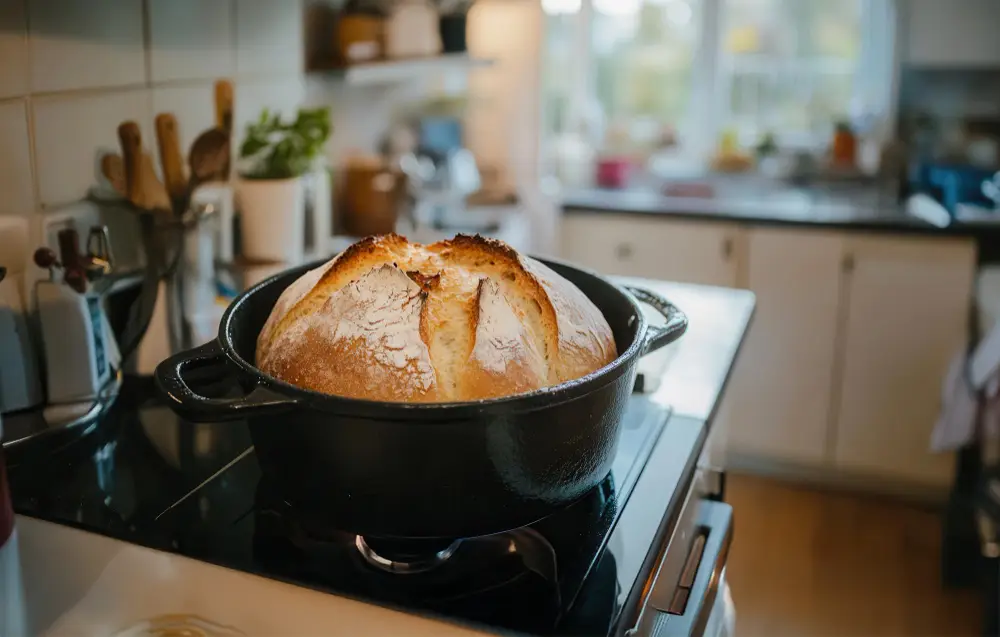
If there is one piece of equipment that genuinely transforms sourdough results, it is a Dutch oven. A Dutch oven — sometimes called a cast iron casserole or French oven — is a heavy, lidded pot that you preheat in the oven and bake your loaf inside.
The reason it matters so much comes down to steam. In the first 15–20 minutes of baking, sourdough needs steam around it to allow the surface of the loaf to expand without setting too quickly. Professional bakeries use deck ovens with injected steam to achieve this. At home, a Dutch oven replicates it beautifully: the moisture in the dough itself creates a steamy environment under the lid.
Without a Dutch oven (or some equivalent), home bakers often end up with loaves that have a good spring in the interior but a thick, set crust that restricts expansion, leading to a denser result than the dough was capable of producing.
Dutch ovens for sourdough come in two main materials:
Cast iron (enamelled or bare)
Cast iron is the traditional choice and for good reason. It holds heat exceptionally well, heats evenly, and produces outstanding results. Enamelled cast iron (such as those made by Le Creuset or Staub) is easy to clean and looks beautiful. Bare cast iron (such as a Lodge combo cooker) is cheaper and performs just as well, but requires a little more maintenance to prevent rust.
The main disadvantage of cast iron is weight. A 4.5-litre cast iron pot can weigh over 5kg, which makes loading and unloading it from a hot oven cumbersome — and potentially dangerous. Many bakers use an oven mitt on each hand and move slowly.
Enamel-on-steel
Enamel-on-steel Dutch ovens are lighter and cheaper than cast iron, but they do not retain heat as effectively and can develop hot spots. They work, but cast iron is a better long-term investment if you plan to bake regularly.
For a round loaf (boule), a 4.5–5 litre Dutch oven is the standard recommendation. If you want to bake a longer oval loaf (batard), you will need an oval pot of equivalent volume.
If you do not have a Dutch oven
You can get acceptable results without one by:
- Using a deep roasting tin inverted over your loaf for the first 20 minutes of baking, creating a makeshift dome
- Placing a tray of boiling water on the bottom shelf of the oven while baking
- Using a covered ceramic baker designed specifically for bread
None of these are quite as effective as a Dutch oven, but they are worth trying before you invest. For more on this and the baking steel alternative, see: Baking Steel vs Dutch Oven for Sourdough.
A Banneton (Proofing Basket)
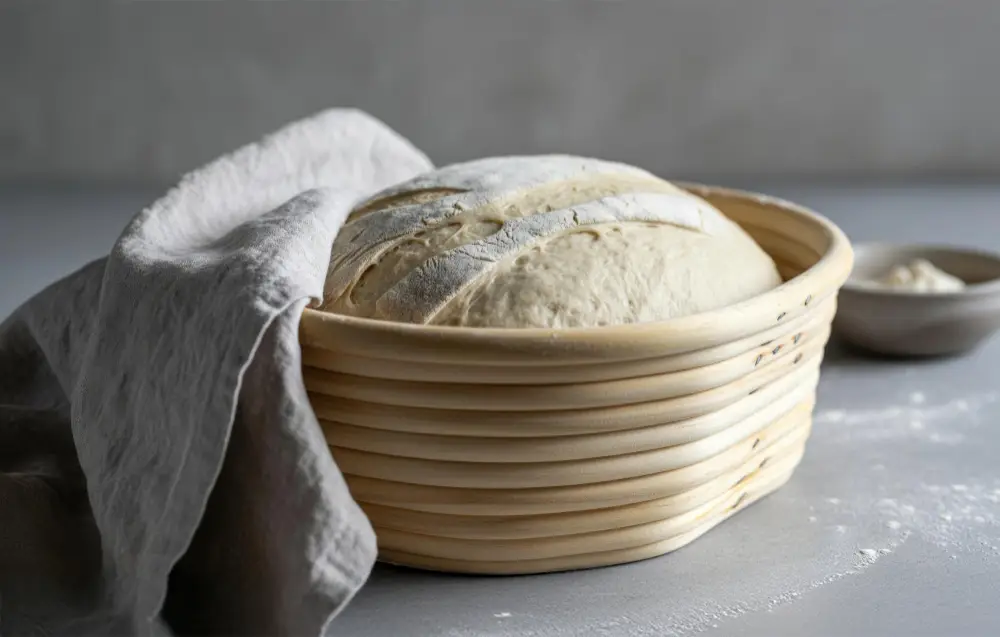
A banneton — also called a proofing basket or brotform — is a basket used to support your shaped dough during its final proof (the second and last rise before baking). Bannetons are typically made from rattan cane and come in round or oval shapes.
Their primary function is structural: they hold the dough in the right shape while it proofs, preventing it from spreading outward. Sourdough doughs, particularly those at higher hydration, will lose their shape quickly on a flat surface. The banneton keeps them tight.
The distinctive spiral pattern you see on the surface of many sourdough loaves comes from the rings of a floured rattan banneton.
Banneton sizes
Bannetons are sized to match your dough weight:
- 500–700g dough: 700g–1 litre basket
- 700g–1kg dough: a 1kg basket (the most common size)
- 1kg+ dough: a larger oval or round basket
Lining and flouring
To prevent dough from sticking, bannetons need to be dusted with flour before use. Rice flour is widely recommended because it is fine, non-glutinous, and does not absorb as readily as wheat flour — meaning it stays in the basket rather than being absorbed into the dough. Many bakers use a 50/50 mix of rice flour and plain white flour.
New bannetons can be treated by wetting and drying them a few times before using, which helps build up a non-stick layer in the rattan fibres.
Linen-lined bannetons
Some bannetons come with a removable linen liner. Linen-lined baskets produce a smooth-surfaced loaf (without the spiral pattern) and are particularly useful for sticky doughs, as linen releases dough more reliably than bare rattan.
Do you actually need a banneton? Technically, no — a floured mixing bowl lined with a well-floured linen tea towel works as a substitute. It is messier and produces less consistent results, but it will get you through your first bakes. For a full breakdown: Do You Need a Banneton? Proofing Basket Guide.
A Bench Scraper
A bench scraper — sometimes called a dough scraper or pastry cutter — is a flat, rectangular blade (usually stainless steel) attached to a handle. It is one of the most versatile tools in baking and costs around £5–10.
In sourdough, a bench scraper is used for:
- Dividing dough cleanly on the bench
- Shaping loaves by tucking under the dough and dragging it towards you to build surface tension
- Scraping sticky dough off the bench without adding extra flour
- Cleaning flour off your work surface after baking
Until you have used one, it is hard to understand quite how much easier it makes shaping. A bench scraper effectively extends your hands, letting you manipulate dough with far more control than fingertips alone allow.
A flexible plastic dough scraper is a useful companion to the stiff metal bench scraper. The plastic version is better for scraping dough from bowls cleanly (its flexibility lets it follow the curve of the bowl) while the metal one is better for bench work.
A Lame (Bread Scoring Blade)
Scoring — slashing the surface of your shaped loaf just before it goes into the oven — is not merely decorative. It controls where the loaf opens as it expands in the heat of the oven. Without a score, the crust sets in the first few minutes of baking before the interior has fully expanded, and the loaf can burst unpredictably at its weakest point rather than opening where you intended.
A lame (pronounced "lahm") is a thin, curved or straight blade mounted on a handle. The blade is typically a standard razor blade, which gives the thin, dragging cut that works best on wet sourdough doughs. A sharp serrated knife is sometimes used as an alternative, but dragging a thick blade through the dough tends to deflate it, producing a flatter loaf.
Dedicated lames come in a variety of designs. The simplest are a wire handle that holds a single razor blade. More refined versions have a curved handle that puts the blade at an angle, making it easier to create the "ear" — the raised lip along a score line that is both beautiful and functional. Bread Lame by Wire Monkey is a popular and well-regarded option available online.
A single-edged razor blade from a hardware shop is a functional alternative in a pinch. You can hold it between two fingers and score carefully, though it is harder to control than a proper handle.
Strongly Recommended Equipment
A Kitchen Thermometer
Temperature is the master variable in sourdough fermentation. The same dough at 18°C will behave very differently to the same dough at 26°C. Wild yeast is more active at warmer temperatures; lactic acid bacteria produce different ratios of acids at different temperatures, affecting flavour.
An instant-read digital thermometer serves several purposes in sourdough:
- Measuring your dough temperature after mixing (your target is typically around 24–26°C)
- Checking water temperature before adding it to dough
- Confirming your loaf is fully baked (a fully baked sourdough reaches an internal temperature of around 96–98°C)
- Monitoring the ambient temperature of your proofing environment
Cheap instant-read thermometers (around £10–15) work perfectly well. Thermapen makes the gold standard of instant-read thermometers, but the jump in price is only justified if you cook meat regularly as well.
A Proofing Box or Consistent Warm Spot
Sourdough fermentation depends on consistent temperature. If your kitchen runs cold in winter (as most UK and Australian kitchens do at various points in the year), your fermentation times will stretch unpredictably, and it becomes harder to learn your dough.
Commercial proofing boxes — essentially small, heated enclosures — give you precise temperature control and take the guesswork out of fermentation timing. The Brod & Taylor folding proofer is the best-known consumer model and folds flat for storage, which makes it more practical for home kitchens.
If you do not want to spend money on a proofing box, free alternatives include:
- Your oven with just the light on (often around 26–28°C)
- The top of your fridge, where the motor vents heat
- A cool box with a small jar of warm water inside
A Dough Whisk (Danish Whisk)
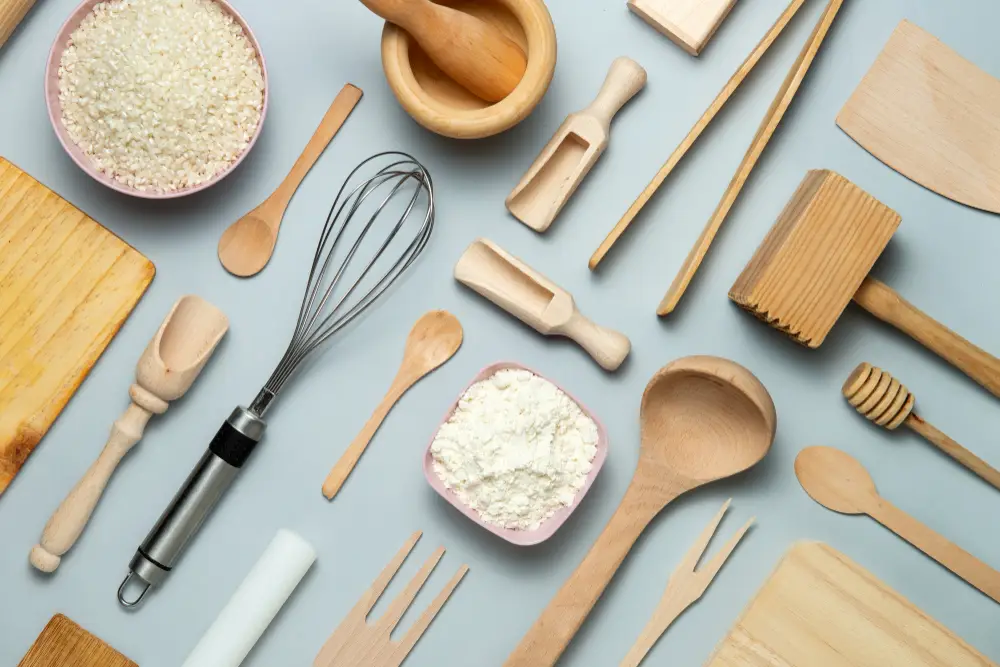
A Danish dough whisk is a wire whisk with an open, looped design that cuts through thick dough without clogging. Mixing sourdough dough by hand can be laborious with a standard whisk or wooden spoon because the dough clings to every wire or curve.
A Danish whisk cuts through the flour-and-water mixture with far less resistance, incorporating the ingredients quickly and efficiently. It is also far easier to clean than a conventional whisk. Expect to pay around £8–12.
This is not an essential item — a stiff spatula and your hands will do the same job — but once you have used one, you will not go back.
A Long, Covered Container for Bulk Fermentation
As your baking becomes more consistent and you want more precision, a straight-sided clear container becomes very useful for bulk fermentation. Unlike a bowl (which is wider at the top than the bottom), a straight-sided container lets you mark the starting level of your dough and measure how much it has risen — a common target is 50–75% volume increase during bulk fermentation, though this varies by recipe.
Cambro polycarbonate food storage containers are the favourite of many serious home bakers for exactly this purpose. They are durable, transparent, rectangular, and come with lids. A 6-litre container suits most home-sized doughs (up to around 2kg total weight).
A Bread Knife
You will need a decent bread knife to slice your finished loaf. This seems obvious, but a blunt or unsuitable knife will compress and tear the crumb — particularly heartbreaking after a lengthy bake. A good serrated bread knife with a long blade (around 25–30cm) will slice cleanly through even a thick, crisp sourdough crust.
Worth Considering Eventually
A Stand Mixer
Sourdough is traditionally mixed and developed by hand — and for most home recipes, hand mixing is entirely adequate. The stretch-and-fold technique used during bulk fermentation (folding the dough over itself every 30–45 minutes) develops gluten progressively without the need for prolonged kneading.
However, if you bake large batches regularly, or if you work with very stiff doughs (like some rye recipes), a stand mixer saves time and effort. A dough hook on a stand mixer can develop a typical sourdough dough in 8–12 minutes. KitchenAid stand mixers are the well-known consumer option; Ankarsrum is the preferred choice of serious bakers for its superior dough hook geometry and larger capacity.
Neither is where we would suggest starting. Develop a feel for dough by hand first.
A Baking Steel
A baking steel is a thick slab of seasoned steel that you preheat on the top shelf of your oven. It retains and conducts heat far more efficiently than a ceramic baking stone and significantly more than an empty oven shelf. Combined with steam (provided by a covered pan of boiling water on the bottom shelf), a baking steel can produce a crust and oven spring that rivals a Dutch oven.
The trade-off is cost and weight — a good baking steel is expensive and extremely heavy. The Dutch oven method is more accessible and just as effective for the majority of home bakers. Read our comparison here: Baking Steel vs Dutch Oven for Sourdough.
Decorative Scoring Stencils
Once you have your basic scoring technique dialled in, decorative stencils and elaborate lame patterns become genuinely enjoyable to explore. Leaf patterns, wheat sheaves, geometric designs — sourdough scoring has become a genuine art form in recent years, and there is a thriving community of bakers sharing designs on social platforms.
This is very much a "when the basics are solid" pursuit rather than a priority for new bakers. Start with a single curved score — the classic ear — and work from there.
A Flour Duster / Shaker
A small duster or fine-mesh shaker loaded with rice flour makes flouring your banneton and work surface much faster and more even. Not essential — a spoon will do — but pleasant to have once your baking routine is established.
A Room-by-Room Equipment Summary
To make this easy to reference, here is everything laid out by phase of the bake:
Before mixing
- Digital scale ✓ Essential
- Kitchen thermometer ✓ Strongly recommended
Mixing and bulk fermentation
- Large mixing bowl ✓ Essential
- Danish dough whisk — Strongly recommended
- Clear straight-sided container — Strongly recommended
Shaping and proofing
- Bench scraper ✓ Essential
- Banneton ✓ Essential (or lined bowl)
- Proofing box / consistent warm spot — Strongly recommended
Scoring and baking
- Lame ✓ Essential
- Dutch oven ✓ Essential (or covered baking method)
Finishing
- Bread knife ✓ Essential
Building Your Kit: A Suggested Budget Approach
Starting from scratch does not have to be expensive. Here is how we would suggest building your kit progressively:
First bake starter kit (under £50)
- Digital scale — £12–20
- Bench scraper — £6–10
- Basic lame — £8–12
- Banneton (1kg round) — £12–18
- Dutch oven — if you do not have a suitable lidded pot, this is the biggest cost. Cast iron Dutch ovens start from around £30 for a basic model and rise steeply from there. Check charity shops and second-hand marketplaces — they turn up regularly and last forever.
Upgrades after your first dozen bakes
- Danish dough whisk — £8–12
- Clear proofing container — £10–15
- Kitchen thermometer — £10–15
Six months in, if you are baking weekly
- Proofing box — £80–100
- Second banneton in a different shape
If sourdough becomes a serious hobby
- Baking steel — £60–100
- Better lame — £20–30
- Stand mixer — £300+
Common Mistakes When Setting Up
Buying before you bake
The most common beginner mistake is purchasing everything on a comprehensive list before making a single loaf. Start with the essentials and let your experience tell you what you actually need. You may find your Dutch oven doubles as your mixing bowl for proofing. You may discover your oven runs hot and you never need a proofing box. Bake first, spend second.
The wrong Dutch oven size
A Dutch oven that is too large for your loaf allows the dough to spread outward before it springs up, producing a wide, flat loaf. For a standard 800g–1kg dough weight, a 4–4.5 litre (24–26cm diameter) Dutch oven is the right size.
Not flouring the banneton properly
Rice flour is far superior to wheat flour for banneton dusting — wheat flour absorbs into the dough surface and can still stick. If you have had a dough tear catastrophically when you tried to flip it out of a banneton, inadequate flouring is almost always the reason. Dust generously, particularly in the first few uses of a new basket.
Ignoring temperature
A kitchen thermometer is not glamorous but it is one of the most useful investments you can make. Many fermentation problems — dough that proofs too quickly, dough that never seems to rise, loaves that are sour when you wanted mild — trace back to temperature variation that bakers were not monitoring.
Using volume measurements instead of weight
This point bears repeating. A cup of flour can vary by 30–40g depending on how it was scooped. In a 500g flour recipe, a 40g error represents an 8% deviation in the flour quantity, which will noticeably affect the dough. Weigh everything.
Caring for Your Equipment
A quick note on maintenance, because a little care extends the life of your tools considerably.
Cast iron Dutch oven: Avoid soap and harsh detergents on bare cast iron — they strip the seasoning. After use, scrub with hot water and a stiff brush, dry thoroughly on the hob over low heat, and rub with a very thin layer of cooking oil. Enamelled cast iron can be washed normally but avoid metal scourers on the enamel.
Banneton: Allow your banneton to dry completely between uses. Never leave damp dough residue in it — it will mould. Do not wash a rattan banneton under water unless absolutely necessary; shake out flour residue and brush gently. If you need to wash it, use a stiff brush with minimal water and dry it in a low oven.
Lame blades: Razor blades dull quickly in contact with wet dough. Many bakers replace the blade every 5–10 bakes. A dull blade drags and deflates dough rather than cutting cleanly. Blades are inexpensive — change them more often than you think you need to.
Bench scraper: The simplest tool to care for. Rinse immediately after use so dough does not dry onto it, and it will last indefinitely.
Connecting Equipment to Process
Understanding your tools is much easier when you understand the process they support. Here is a brief overview of how each piece of equipment fits into a complete sourdough bake, with links to the detailed guides for each stage.
1. Feed your starter (12–24 hours before baking)
Tools needed: scale, jar, spoon.
See: How to Know When Your Sourdough Starter Is Ready to Bake With
2. Mix your dough
Tools needed: scale, large bowl, dough whisk or hands.
Flour, water, salt, and starter are combined. The exact quantities follow your recipe.
3. Autolyse (optional)
Tools needed: bowl, cover (cling film or damp tea towel).
Flour and water are mixed and left to rest before adding starter and salt. This pre-hydration helps develop gluten without much effort.
4. Bulk fermentation
Tools needed: clear container or covered bowl, thermometer.
The dough rests at room temperature, usually with sets of stretch and folds every 30–45 minutes for the first few hours. This is the most important phase of the bake. See: Bulk Fermentation Explained
5. Shaping
Tools needed: bench scraper, work surface.
The fermented dough is shaped into a boule or batard. See: How to Shape Sourdough Bread (Boule and Batard)
6. Final proof
Tools needed: banneton, proofing box or warm spot, linen liner (optional).
The shaped dough proofs again — either at room temperature for a few hours or in the fridge overnight (cold retard).
7. Score and bake
Tools needed: Dutch oven preheated in oven, lame, oven gloves.
The dough is turned out of the banneton, scored, and lowered into the hot Dutch oven. See: Scoring Sourdough: Patterns, Tools, and Technique
8. Cool and slice
Tools needed: wire cooling rack, bread knife.
This step is more important than it sounds. Sourdough needs to cool for at least one hour — ideally two — before slicing. Cutting too soon releases steam and causes the crumb to gum and compress.
Frequently Asked Questions
Can I make sourdough without a Dutch oven?
Yes, though your results will be less consistent. The alternatives — a roasting tin inverted over the loaf, or a tray of boiling water in the oven — can produce good results but require more trial and error. If you bake often, a Dutch oven is worth the investment. See our full comparison: Baking Steel vs Dutch Oven for Sourdough.
What is the best flour for beginners?
A strong white bread flour with 12–13% protein is the most forgiving starting point. It gives you the best gluten development with the least difficulty. Once you are comfortable with the process, start blending in small amounts of wholemeal or rye for more complex flavour. For more detail: The Best Flour for Sourdough Bread.
Does water quality really matter?
In most cases, tap water is fine. If your fermentation is sluggish and your starter appears healthy, try switching to filtered or overnight-rested water. Full guide: Sourdough and Water: Does Water Quality Actually Matter?.
How long does equipment last?
Cast iron Dutch ovens and metal bench scrapers, if cared for, will outlast you. Bannetons last many years with proper drying and storage. Lame blades are consumables — change them regularly. A good scale should last at least five to ten years with normal use.
Do I need a stand mixer?
No. Most home sourdough recipes are designed to be made by hand. Stretch-and-fold technique replaces the need for prolonged mechanical kneading. A stand mixer is a convenience for high-volume baking, not a necessity.
Ready to Go Further?
Understanding your ingredients and equipment is the foundation of confident sourdough baking. The next step is getting flour on your hands and dough in a bowl.
If you are working through our learning sequence, the logical next move is our complete recipe guide: How to Make Classic Sourdough Bread: A Complete Guide. It walks you through a full bake using every piece of equipment covered here, with detailed explanations of what is happening at each stage and why.
If you run into problems along the way, our comprehensive troubleshooting guide covers every common failure mode: Sourdough Troubleshooting: Fix Every Common Problem.
And if you want to shortcut the learning curve — if you would rather start with hands-on guidance from an experienced baker than learn alone through trial and error — our sourdough workshops are designed for exactly that. In three hours, you will mix, shape, score, and bake a full sourdough loaf in a real kitchen environment with expert support throughout. Find out more about what to expect: What to Expect at a Sourdough Bread-Making Workshop.
Not sure which workshop is right for you? We run sessions focused on classic sourdough, rye sourdough, and gluten-free sourdough — each tailored to a different style of baking and a different set of skills. Our comparison guide will help you choose: Classic vs Rye vs Gluten-Free: Which Workshop Is Right for You?.
Explore more from the Ingredients & Equipment category: