
Things Our Students Wish They Knew Before Their First Bake
Every workshop we run ends the same way. Flour on the benches, loaves wrapped and ready to go home, and a room full of people looking a little surprised at what they just pulled off.
Then someone says it.
"I wish I'd known that before I wasted three months trying to figure it out on my own."
It happens every single time.
After running hundreds of sourdough workshops with students of all skill levels, we've heard the same regrets come up again and again. Not complicated ones — just the small things that nobody tells you at the start. The things that would have saved a lot of dense loaves, frustrated mornings, and jars of abandoned starter.
This article is our attempt to share all of it before you even pick up a bag of flour.
1. Your Starter Is the Whole Game
Most beginners think the starter is just step one — something to get through before the "real" baking starts. It isn't. Your starter is the engine behind everything. Every rise, every bubble in the crumb, every bit of flavour comes from it.
If your starter isn't active and healthy, nothing else you do will save the loaf.
The single most common reason a first sourdough fails is that the baker didn't wait long enough for their starter to be ready. The starter looked bubbly, it smelled okay, so they went ahead. But "looks kind of active" and "is genuinely ready to bake with" are two very different things.
Before you bake, your starter should:
- Double (or close to it) within 4–8 hours of a feed
- Have a domed top at its peak — not flat or collapsed
- Smell pleasantly sour and yeasty, not like nail polish remover or blue cheese
- Pass the float test: drop a small spoonful into water; if it floats, it's ready
If you're still building your starter from scratch, our step-by-step guide to making a sourdough starter walks you through every stage, including the signs of readiness that beginners often miss.
2. Temperature Controls Everything (Not the Clock)
This is the one that trips up almost every new baker.
A recipe says "bulk ferment for 4 hours." You set a timer and walk away. Four hours later, the dough is either over-fermented and sticky, or still dense and under-risen — because your kitchen isn't the same temperature as the recipe author's kitchen.
Wild yeast is highly sensitive to temperature. According to research on sourdough fermentation kinetics, fermentation activity roughly doubles with every 5°C increase in temperature. A dough fermenting at 26°C will be ready in roughly half the time of one sitting at 20°C.
What this means for you:
- In a warm kitchen (24–27°C), bulk fermentation might take 4–5 hours
- In a cool kitchen (18–21°C), expect 6–10 hours or more
- In winter, your dough may barely move at all if left on the bench
Learn to read your dough, not the clock. By the end of bulk fermentation, the dough should have grown by 50–75%, feel lighter and more airy than when you started, and jiggle gently when you shake the bowl. Those physical signs matter far more than the time on your kitchen timer.
3. Sourdough Takes Days, Not Hours
Before their first workshop, many of our students imagine sourdough as a same-day project. Mix in the morning, bake by dinner. That's not quite how it works.
A standard sourdough bake looks more like this:
- Evening, Day 1: Feed your starter
- Morning, Day 2: Mix the dough, autolyse, add starter and salt
- Day 2, daytime: Stretch-and-fold sessions, then bulk fermentation
- Evening, Day 2: Shape, place in banneton, refrigerate overnight
- Morning, Day 3: Bake straight from the fridge
That cold overnight proof (called retarding) isn't just a convenience — it develops flavour, makes the dough easier to score, and often improves oven spring. You can read more about the full process in our complete classic sourdough bread guide.
The good news is that most of this time is hands-off. The dough does the work; you just check in on it. Once you understand the timeline, it fits into real life quite easily. It just requires planning the day before, not the morning of.
4. A Dense Loaf Isn't a Disaster — It's Information
Every new baker produces at least one dense, heavy loaf that could double as a doorstop. It's practically a rite of passage.
The mistake isn't the dense loaf itself. The mistake is throwing your hands up and deciding sourdough isn't for you.
Dense bread is diagnostic. It's telling you something specific went wrong — and once you know what, you can fix it. The most common causes are:
- Starter wasn't ready — the most frequent culprit by far
- Under-fermentation — the dough didn't have long enough to develop gas
- Over-fermentation — the structure broke down and couldn't hold the gas
- Shaping too tight or too loose — either can kill oven spring
Our full sourdough troubleshooting guide covers every symptom with specific fixes, and our dedicated article on why sourdough goes dense will help you diagnose your specific situation.
The bakers who improve fastest are the ones who treat every imperfect loaf as data, not failure.
5. Hydration Is a Dial, Not a Requirement
Most beginner sourdough recipes start with 70–75% hydration (meaning 700–750g of water per 1,000g of flour). That's a good starting point — but it's not a rule you have to follow.
Higher hydration doughs tend to produce a more open, irregular crumb with large holes. They also tend to be sticky, hard to shape, and very unforgiving if your fermentation timing is even slightly off. For a beginner, a high-hydration loaf can feel like wrestling with wet cement.
Here's what we tell our workshop students: start lower. A 65–68% hydration dough will still produce a beautiful, flavourful loaf. It will be far easier to handle, shape, and score. Once you've baked a few and understand how the dough should feel and behave, you can gradually increase the water and see how it changes things.
You can learn more about how the numbers work in our guide to understanding hydration in sourdough.
6. You Don't Need Fancy Equipment to Start
Before their first workshop, some students arrive expecting a long shopping list. Dutch oven, linen-lined banneton, a Danish dough whisk, a bench scraper, a lame...
You don't need all of it. Not at the start.
Here's what actually matters for your first few bakes:
- A Dutch oven (or any heavy, lidded oven-safe pot) — this is the one piece of equipment worth investing in. The trapped steam is what gives you a crackling crust and proper oven spring. A study published in Cereal Chemistry confirms that steam in the early stages of baking is critical for crust development and loaf volume.
- A kitchen scale — baking by weight, not volume, is non-negotiable in sourdough. A $15 digital scale is all you need.
- A mixing bowl — any large bowl works
- A bench scraper — inexpensive and genuinely useful for shaping
A banneton is lovely once you're baking regularly, but a bowl lined with a well-floured tea towel does the same job. Our equipment guide covers everything from essential to nice-to-have, so you can spend wisely.
7. Scoring Isn't Just Decorative
The pattern you slash into the top of your dough before it goes in the oven isn't just for looks. It's a pressure valve.
As the dough heats up, it expands rapidly. If there's no weak point to expand through, the crust will burst somewhere unpredictable — usually along the side. A proper score gives the dough a controlled direction to grow, which is what creates the dramatic ear you see on professional loaves.
For your first loaf, forget the elaborate wheat stalks and leaf patterns. A single deep slash at a 30–45° angle, made quickly and confidently with a sharp blade (a lame or a razor blade works best) is all you need. Hesitating and dragging the blade will deflate your dough.
Confidence is actually the technique here.
8. The Fridge Is Your Friend
Many beginners are nervous about the cold proof. Surely the dough needs to stay warm to keep fermenting? What if it gets too cold?
In practice, the fridge is one of the most useful tools in your sourdough kit.
Proofing your shaped dough in the fridge overnight (anywhere from 8 to 16 hours) does a few things. It slows fermentation right down without stopping it, which means:
- You're not trying to time the oven perfectly at the end of a long ferment
- The dough firms up, making it much easier to score cleanly
- The long, cold fermentation develops more complex acidity and flavour
- You can bake it in the morning when you're fresh and ready, not exhausted at midnight
Cold dough goes straight from the fridge into a screaming hot Dutch oven. No need to bring it to room temperature first — that temperature shock actually helps oven spring.
9. Sourdough Smells Strong — That's Normal
First-time bakers are sometimes alarmed by their starter. It can smell intensely sour, vinegary, or almost like cheese. Some starters go through a phase where they smell genuinely unpleasant, especially in the first week or two.
This is almost always completely normal.
The smell of your starter tells you about its microbial balance. Hooch (a grey liquid that forms on top) just means it's hungry — pour it off and feed the starter. A sharp vinegary smell often indicates acetic acid production, which can be influenced by temperature and feeding schedule. According to research on sourdough microbiology, the balance between lactic and acetic acid bacteria determines both the smell and flavour profile of the finished bread.
The only smells you should genuinely worry about are mould (pink, orange, or fuzzy growth) or an overwhelmingly chemical, almost paint-like smell that doesn't go away after a few feeds. Everything else is just your starter doing its thing.
10. Learning in Person Changes Everything
This is the one our students say most often after their workshop — usually while they're tying up their apron on the way out.
"I tried to learn this from YouTube for months. I understood it in about forty minutes here."
Reading a recipe or watching a video can only take you so far with sourdough. The critical moments — knowing when the dough feels right, understanding what "just shaping tension" means in your hands, recognising what properly fermented dough looks like — are things you absorb by doing, not reading.
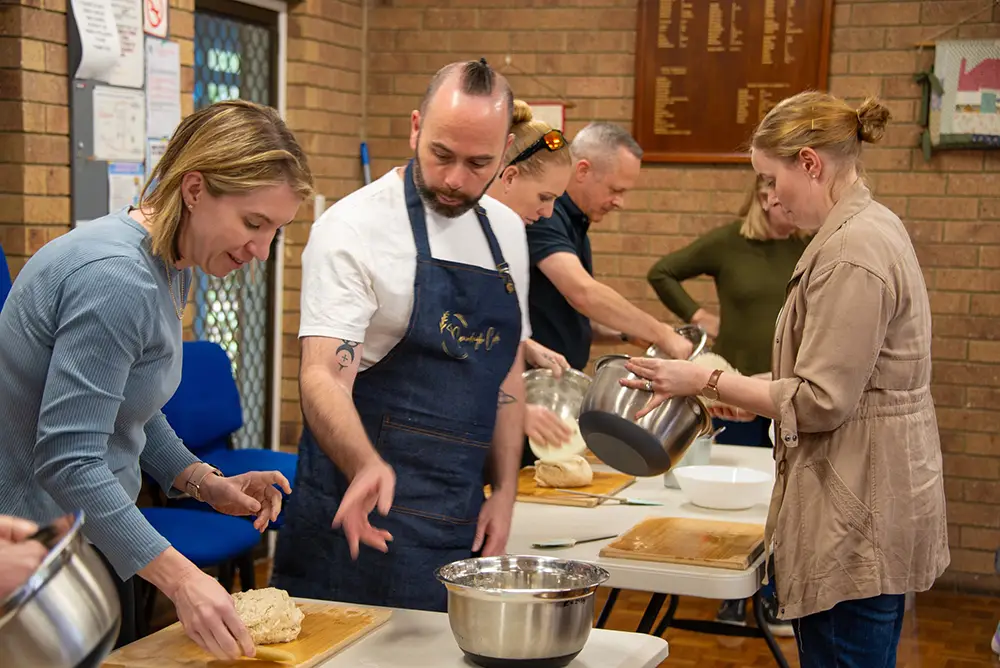
In a workshop setting, you get immediate feedback. When you're shaping and you're pulling too hard or not enough, someone can correct it in real time. When you're unsure whether your starter is ready, you can compare it directly to one that definitely is. Those moments of live comparison collapse weeks of solo trial and error.
If you've been struggling on your own and feeling like you're missing something — you probably are, and it's the hands-on experience.
Ready to Skip the Hard Part?
Everything above is learnable on your own. It will just take longer, and involve more disappointing loaves, than it needs to.
Our sourdough workshops are designed to cover all of it in a single three-hour session. You'll leave with a shaped loaf to bake at home, a fed starter, and the practical understanding that makes everything click.
Not sure which workshop is right for you? Our Classic vs Rye vs Gluten-Free comparison guide breaks down exactly what each one covers and who it's suited to. Or visit the workshop page to see upcoming dates and what to expect on the day.
Have a question before you book? We'd love to hear from you.