

How to Store Your Sourdough Starter in the Fridge
You've built a healthy, active sourdough starter — and now you're wondering whether you have to feed it every single day forever. The good news is that you don't. Storing your sourdough starter in the fridge is one of the most practical habits you can build as a home baker. It slows fermentation right down, reduces how often you need to feed it, and keeps your starter alive and ready to bake with for weeks at a time.
This guide covers everything you need to know about fridge storage: how to prepare your starter before it goes in, how often to feed it while it's there, and how to get it back up to full strength before your next bake.
Why the Fridge Works for Sourdough Starters
Sourdough starters are colonies of wild yeast and lactic acid bacteria. At room temperature, these microorganisms are highly active — they consume the flour you feed them and produce carbon dioxide and organic acids within a matter of hours. This is great when you're baking every day, but not when you want a few days off.
Cold temperatures slow microbial activity significantly without killing it. Research published in Food Microbiology confirms that lactic acid bacteria remain viable at refrigeration temperatures (around 4°C), they simply enter a slower, dormant-like state. This means your starter can sit in the fridge for days — or even a couple of weeks — without losing viability, as long as you feed it correctly before and after.
Think of fridge storage as putting your starter into a low-energy sleep mode. It's not dead, it's resting.
What You Need
Before you store your starter in the fridge, make sure you have:
- A clean glass jar with a loose-fitting lid (or a lid placed loosely, not screwed tight)
- Enough starter to maintain — most home bakers keep 50–150g
- Your usual flour for feeding
- A kitchen scale for accurate ratios
Avoid airtight lids unless your jar has a pressure-release mechanism. Fermentation produces carbon dioxide, and even a dormant starter in the fridge can build pressure. A lid that sits on top without sealing, or a jar with a rubber seal loosened by one turn, is the safer option.
How to Prepare Your Starter for the Fridge
Step 1: Feed it first
Always feed your starter before putting it in the fridge. This gives the microorganisms a fresh supply of food to sustain them during cold storage.
Use a 1:1:1 ratio as a starting point — equal parts starter, flour, and water by weight. For example:
- 50g starter
- 50g flour
- 50g water
Mix thoroughly until no dry flour remains. A well-fed starter should look smooth and slightly thick.
Step 2: Let it begin to activate
Leave the fed starter at room temperature for about 1–2 hours before refrigerating. You don't need to wait for it to reach peak activity — just long enough for fermentation to get going. This gives the microorganisms a head start and means your starter won't arrive in the fridge in a completely flat, unfed state.
Step 3: Transfer to the fridge
Place the jar in the fridge with the lid on loosely. Write the date on the jar with a piece of masking tape if you tend to lose track of time. A starter stored this way will stay healthy and viable without attention for up to one week with ease, and often longer.
How Often to Feed Your Starter in the Fridge
For most home bakers who bake once or twice a week, feeding your starter once a week is sufficient. Here's a simple weekly routine:
- Remove the jar from the fridge
- Discard or use a portion of the starter (see below)
- Feed with fresh flour and water at your usual ratio
- Leave at room temperature for 1–2 hours
- Return to the fridge
If you go longer than two weeks without feeding, your starter can still survive but you may notice a layer of grey or dark liquid forming on top. This liquid is called "hooch" — it's a byproduct of fermentation and a sign your starter is hungry. It isn't harmful. Simply pour it off or stir it back in, then feed the starter and give it a few refreshments at room temperature before baking with it.
What to Do with the Discard
Each time you feed your starter, you'll typically remove some of the old starter to prevent the jar from overflowing and to keep feeding quantities manageable. This removed portion is called sourdough discard.
Discard from the fridge isn't wasted — it's a useful ingredient. It has a more pronounced sour flavour than active starter, which works well in:
- Pancakes and crumpets
- Flatbreads and pizza dough
- Crackers and crispbreads
- Banana bread and muffins
For a full list of ideas, visit our guide on What to Do with Sourdough Discard.
How to Wake Your Starter Before Baking
A cold starter that's been sitting in the fridge for a week isn't ready to leaven bread straight away. It needs time to warm up and become active again. Here's a reliable process:
12–24 hours before you plan to mix dough
Refreshment 1: Remove the starter from the fridge. Discard down to 20–30g, then feed at a 1:2:2 or 1:3:3 ratio (starter:flour:water by weight). Leave at room temperature (ideally 24–26°C).
Refreshment 2 (if needed): If your starter isn't showing strong activity (bubbles, dome, doubled in size) after 8–12 hours, give it a second feed at the same ratio. Some starters, especially after a long cold rest, need two refreshments to fully wake up.
How to know it's ready
Your starter is ready to use when it:
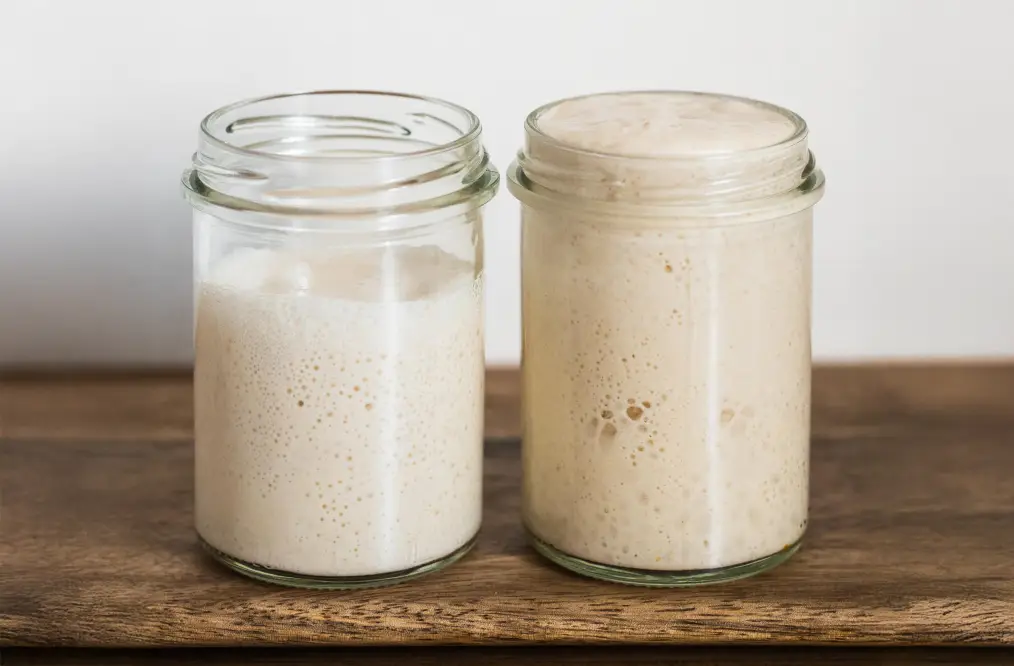
- Has roughly doubled in size since feeding
- Looks bubbly and domed on top
- Smells pleasantly yeasty and slightly tangy, not overpoweringly acidic
- Passes the float test — a small spoonful dropped into water floats
Don't skip this step. Baking with a cold, sluggish starter is one of the most common causes of a dense, flat loaf. Our Sourdough Troubleshooting Guide covers this in detail if you've already run into problems.
Choosing the Right Jar and Container
The container you use matters more than you might think.
Glass jars are the most popular choice among home bakers for good reason. Glass doesn't absorb odours, is easy to clean, and allows you to see the starter's activity level through the sides. A straight-sided jar makes it especially easy to track how much your starter has risen — some bakers use a rubber band or a piece of tape to mark the level after feeding.
Weck jars and wide-mouth Mason jars both work well. Aim for a jar that's roughly 3–4 times the volume of your starter so there's space for it to expand.
Plastic containers are fine but should be food-grade and well-sealed. Avoid containers that have absorbed strong odours from other foods.
Fridge Temperature and Placement
A standard domestic fridge runs between 2°C and 5°C. The back of the fridge is usually the coldest spot, while the door shelves are warmest due to temperature fluctuations each time the door opens. The middle shelf tends to be the most stable place to store your starter.
If your fridge runs very cold (close to 0°C), fermentation will be nearly halted entirely, which means you may need to feed a little more frequently or allow a longer warm-up time before baking. A simple fridge thermometer is a cheap way to know what you're working with.
Long-Term Storage: What If You're Away for Several Weeks?
If you're going away for a month or more, you have two options beyond weekly feeding:
Option 1: Ask someone to feed it
Leave clear instructions — a 1:1:1 feed once a week is all that's needed. Most people find this easier than it sounds.
Option 2: Dry your starter
You can dehydrate a portion of your starter by spreading a thin layer on a piece of baking paper and leaving it to dry at room temperature for 24–48 hours. Once fully dry and brittle, crumble it into flakes and store in an airtight container in the fridge or freezer. Dried starter can last for years and can be rehydrated with flour and water when you return. The BBC Good Food guide to sourdough starters covers this approach well.
Common Questions About Fridge Storage
Can I store my starter in the freezer instead?
Yes, for very long-term storage — months or years. However, freezing is less convenient for regular bakers because the thaw-and-revive process takes longer. The fridge is the better choice if you bake at least a few times a month.
My starter has a dark liquid on top. Is it ruined?
No. This is hooch — a mixture of alcohol and water produced during extended fermentation. It means your starter is hungry. Pour it off, discard most of the starter, feed generously, and give it two or three refreshments at room temperature before baking. For a more detailed rescue plan, read our guide on How to Revive a Neglected Sourdough Starter.
Can I use my starter straight from the fridge?
For most recipes, no. A cold starter isn't active enough to reliably leaven bread. There are some recipes — like long cold-fermented doughs — that factor in a slower rise, but for standard sourdough loaves, always warm and refresh your starter first.
How long can a starter survive in the fridge without feeding?
A healthy, well-established starter can typically survive two to three weeks in the fridge without feeding. Beyond that, it will weaken and acidify, but it's rarely beyond saving. King Arthur Baking's sourdough resources suggest a maximum of two weeks between feeds for reliable results.
Quick-Reference: Fridge Storage Summary
| Situation | Action |
|---|---|
| Baking once a week | Feed weekly, refresh starter 12–24 hrs before baking |
| Baking less than once a week | Feed weekly regardless, even if not baking |
| Going away for 1–2 weeks | Feed before you leave, refresh well on return |
| Going away for a month or more | Dry the starter or arrange for someone to feed it |
| Hooch on top | Pour off, feed generously, refresh at room temperature |
| Starter smells very acidic | Two or three refreshments at room temperature before using |
The Bigger Picture
Learning to maintain a healthy starter in the fridge is one of the habits that separates occasional bakers from confident, consistent ones. Once you have a reliable routine in place — feed on the weekend, bake mid-week — it becomes second nature.
If you'd like to build these skills alongside an expert in a hands-on setting, our Sourdough Bread-Making Workshops cover starter care, feeding schedules, and the full baking process in a single three-hour session. It's one of the best ways to shortcut months of trial and error.
For everything else about keeping your starter in great shape over the long term, head back to our full guide: Maintaining a Sourdough Starter: The Long-Term Care Guide.