
Sourdough Terminology Decoded: A Glossary for New Bakers
If you've ever searched for a sourdough recipe and ended up more confused than when you started, you're not alone. Words like autolyse, banneton, and oven spring get thrown around as if everyone already knows what they mean. They don't.
This sourdough glossary cuts through the jargon. Every term is explained in plain English, so you can follow any recipe, troubleshoot any problem, and eventually hold a real conversation with the most serious bread nerds in the room.
Bookmark this page. You'll come back to it.
Why sourdough has its own language
Sourdough baking draws from professional bakery traditions, food science, and baking communities across several countries and languages. Many terms come directly from French (the language of classic professional baking) or have very specific technical meanings that matter a lot when things go wrong.
Understanding the vocabulary isn't about sounding clever — it's about being able to diagnose problems, follow instructions accurately, and understand why each step exists.
If you're brand new to sourdough, start with our complete beginner's guide to sourdough bread before diving deep into the terminology. If you're already mid-journey and just need a reference, you're in the right place.
The sourdough glossary: A–Z
A
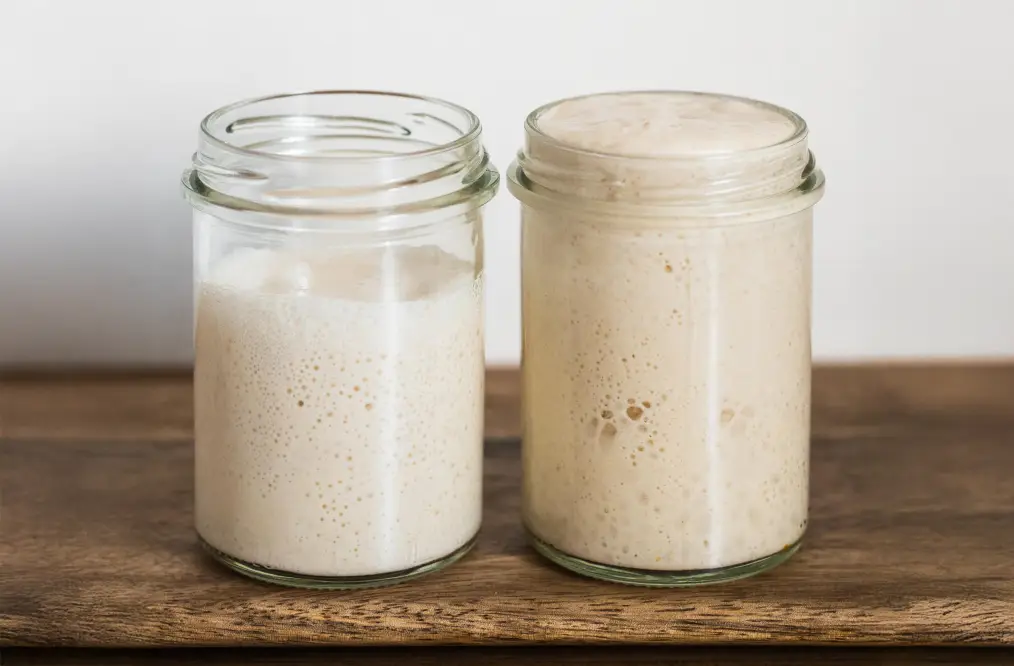
Active starter A sourdough starter that has been recently fed and is currently fermenting — meaning it's producing gas bubbles, increasing in volume, and ready (or approaching ready) to use in a bake. An active starter is visibly alive: bubbly, domed, and slightly tangy in smell. Contrast with a discard or a starter that has been refrigerated and gone dormant.
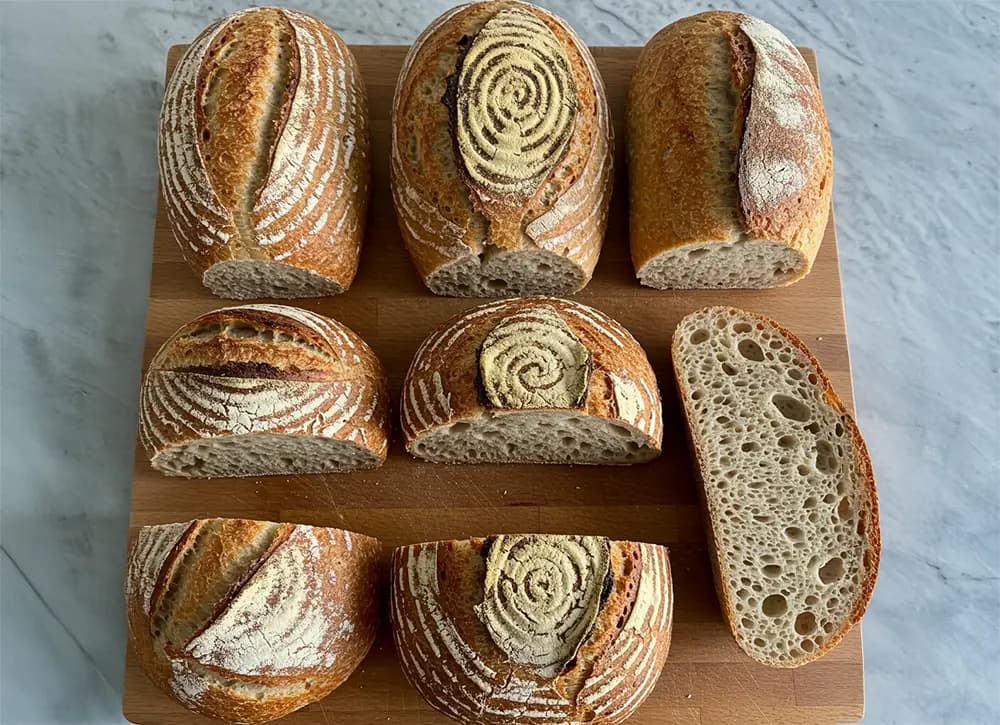
Alveoli The air pockets inside a baked sourdough loaf. These are created by gas produced during fermentation and then set when the bread bakes. Larger, more irregular alveoli = a more open crumb. Smaller, uniform alveoli = a tighter crumb.
Autolyse (also: autolysis) A rest period — usually 20 to 60 minutes — where flour and water are mixed together without the starter or salt. During this time, the flour absorbs water fully, gluten begins developing on its own, and the dough becomes easier to work. Adding salt or starter before autolyse is complete can interfere with enzyme activity. The technique was developed and popularised by French baker Raymond Calvel.
B
Banneton (also: proofing basket, brotform) A basket — typically made from cane, rattan, or wood pulp — used to support dough during its final proof. Bannetons give the loaf its shape while it rests, and when dusted with rice flour, create the decorative spiral pattern you see on many artisan loaves. They don't go in the oven. You tip the dough out onto your baking surface before baking.
Batard A French word meaning bastard, but in baking it refers to an oval-shaped loaf — the middle ground between a round boule and a long baguette. Batards are popular because they're easier to slice, toast evenly, and still develop excellent crust and crumb when shaped well.
Bench rest (also: pre-shape rest) A short rest period — usually 20 to 30 minutes — after the dough has been pre-shaped and before it is given its final shape. Bench resting relaxes the gluten, making the dough more pliable and less likely to tear when you shape it.
Boule From the French word for ball. A round, free-form sourdough loaf — the most classic shape in home baking. Boules are shaped by building surface tension in the dough, then proofed seam-side-up in a banneton or bowl lined with a floured cloth.
Bran The hard outer layer of a wheat grain, removed during the milling of white flour. Bran is retained in wholemeal and stoneground flours. In sourdough, bran adds flavour and nutrition but can cut gluten strands, producing a denser crumb if the dough isn't handled carefully.
Brotform See banneton. Brotform is the German word for the same type of proofing basket. You'll see both terms used, often interchangeably.
Bulk fermentation (also: bulk rise, first rise) The most important fermentation stage in sourdough baking. After mixing the dough with your starter, you leave the whole batch (the bulk) to ferment at room temperature. During this stage, wild yeast produces gas, lactobacilli produce acid, gluten develops strength, and the dough's flavour, structure, and texture are largely determined. Get this stage right and everything else is manageable. Get it wrong and no amount of careful shaping or baking will save the loaf.
C
Cold proof (also: retard, cold retard, overnight proof) A final proof that takes place in the refrigerator rather than at room temperature, typically overnight. The cold slows fermentation dramatically without stopping it. Benefits include: more developed flavour, a firmer dough that's easier to score, and flexibility in timing your bake. Many bakers bake their loaves directly from the fridge into a preheated Dutch oven.
Couche A heavy linen cloth used by professional bakers to support baguettes or batards during the final proof. At home, a well-floured tea towel works in a similar way.
Crumb The interior texture of a baked loaf — the network of air pockets, structure, and chew. Crumb is described as open (large, irregular holes), tight (small, even holes), gummy (underbaked), or wild (very large, uneven holes). The crumb is the most talked-about feature of a sourdough loaf, and one of the hardest to consistently control.
D
Discard The portion of your starter that you remove before feeding it. Rather than letting your starter grow indefinitely, you remove some each time you feed it. Discard isn't dead or unusable — it can be used in pancakes, crackers, flatbreads, and many other recipes. It just isn't active enough to leaven a full loaf on its own. Our article on sourdough discard covers what you can do with it.
Dough temperature (also: desired dough temperature, DDT) The temperature of the dough after mixing. Dough temperature has a direct effect on fermentation speed. Warmer dough ferments faster; cooler dough ferments slower. Professional bakers calculate DDT precisely, adjusting their water temperature to hit a specific target (typically around 24–26°C for most sourdough recipes). Home bakers don't need to be this precise, but understanding that a cold kitchen means slower fermentation (and vice versa) is essential.
Dutch oven (also: combo cooker, cast iron cocotte) A heavy, lidded cast-iron pot used to bake sourdough at home. When you place shaped dough inside and put on the lid, the steam trapped inside replicates the steam-injected professional ovens used in bakeries. That steam keeps the crust soft in the early stages of baking, allowing the loaf to expand fully before the crust sets. The result: better oven spring, a thinner crust, and a more open crumb.
E
Ear The raised ridge of crust that forms along a score line when a loaf bakes well. A prominent ear is the hallmark of a properly scored, well-fermented loaf. It forms when the dough expands rapidly and the scored edge curls back and crisps.
Enriched dough A dough that contains added fats, sugars, eggs, or dairy — like brioche or milk bread. Most traditional sourdough is lean dough (flour, water, salt, starter), but enriched sourdough exists and behaves quite differently because fats coat gluten strands and slow fermentation.
Extensibility A dough's ability to stretch without tearing. Extensibility and elasticity work in opposition: a dough needs some of both. Too elastic and it springs back too quickly to shape; too extensible and it has no structure. The balance between these qualities is developed during fermentation and through careful handling.
F
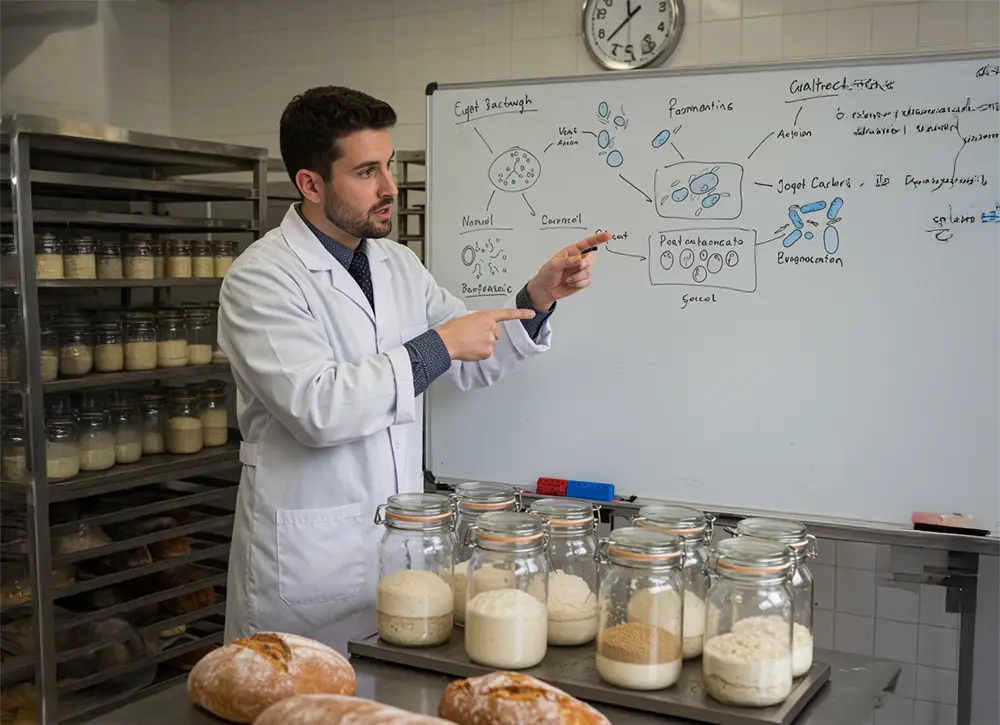
Fermentation The biological process at the heart of sourdough. Wild yeast in your starter converts sugars from the flour into carbon dioxide (which makes the bread rise) and ethanol (which mostly evaporates). At the same time, lactic acid bacteria produce lactic acid and acetic acid, which give sourdough its distinctive flavour. Temperature, time, and the health of your starter all influence how fermentation develops. For a deeper look, read our article on the science of sourdough fermentation.
Folds (also: stretch and fold, coil fold, lamination) Techniques used during bulk fermentation to develop gluten strength without traditional kneading. Rather than working the dough all at once, you perform gentle folds at intervals (typically every 30 minutes for the first couple of hours). Different folding methods — stretch and fold, coil fold, Rubaud method — have different effects on dough strength and gas retention.
Float test A simple test for checking whether your starter is active and ready to use. Drop a small spoonful of starter into water. If it floats, it contains enough gas to leaven bread. If it sinks, it likely needs more time after feeding, or the starter may need attention. The float test is a useful guide but not infallible — some healthy starters sink and still bake beautifully. Learn more about how to know when your starter is ready.
Flour extraction rate A measure of how much of the wheat grain ends up in the flour after milling. White flour has a low extraction rate (typically 70–75%) because the bran and germ are removed. Wholemeal flour has a 100% extraction rate — nothing is removed. Higher extraction flours ferment faster and produce denser, more flavoursome bread.
G
Gluten A network of proteins — primarily glutenin and gliadin — that forms when wheat flour is mixed with water. Gluten gives dough its elasticity and extensibility, traps gas during fermentation, and creates the chewy structure of baked bread. Gluten development is influenced by hydration, kneading, folding, fermentation time, and the protein content of the flour.
Gluten window (also: windowpane test) A test used to check gluten development. Take a small piece of dough and gently stretch it between your fingers. If it stretches thin enough to become semi-translucent without tearing — like a windowpane — the gluten is well developed.
H
Hydration The ratio of water to flour in a dough, expressed as a percentage. A dough made with 500g of flour and 375g of water is 75% hydration. Higher hydration doughs (80%+) produce more open crumbs but are stickier and harder to shape. Lower hydration doughs (65–70%) are easier to handle and produce a tighter crumb. For a full explanation, see our guide to sourdough hydration.
I
Inoculation The percentage of starter added to a dough, calculated as a proportion of the total flour weight. A higher inoculation means faster fermentation; a lower inoculation means slower, more flavour-complex fermentation. A typical range is 10–20% for most home baking recipes.
L
Lame (pronounced: lahm) A French word for blade. In baking, it refers to the small, razor-sharp tool used to score sourdough before it goes in the oven. A lame typically holds a thin blade at a slight curve, which allows the baker to make precise, controlled cuts that open into an ear during baking. A sharp bread knife or craft blade can substitute, but a dedicated lame gives the most control.
Leaven (also: levain) Interchangeable terms for the sourdough starter used to leaven (raise) a loaf. Some bakers use levain specifically to refer to a preferment built from the main starter — i.e., a portion of the starter fed with specific flour and water ratios a few hours before mixing the final dough. Leaven is more commonly used in British English; levain in American and French contexts.
Lactic acid One of two main acids produced by lactic acid bacteria during fermentation. Lactic acid gives sourdough a mild, yoghurt-like flavour. It is produced in greater quantities at warmer temperatures and in wetter, more hydrated doughs. Lactic acid is also the primary acid in a slower, gentler fermentation.
M
Maillard reaction The chemical reaction between amino acids and sugars that produces the brown crust and complex flavours of baked bread. The Maillard reaction requires high heat — it begins around 140°C and increases rapidly beyond that. This is why a well-baked sourdough has a deep, dark crust: that colour is flavour.
Mise en place A French cooking term meaning everything in its place. In sourdough, it means having your flour weighed, your water measured, your starter ready, and your workspace prepared before you start. Good mise en place prevents the rushed mistakes that cause baking problems.
O
Open crumb A crumb structure characterised by large, irregular air holes. Open crumb is the goal of many intermediate and advanced sourdough bakers — it indicates good fermentation, good gluten development, and careful shaping. Achieving an open crumb requires a specific balance of hydration, fermentation, and shaping technique.
Oven spring The rapid rise that occurs in the first 10–15 minutes of baking, as heat causes the gases inside the dough to expand rapidly and the yeast has one final burst of activity before dying from the heat. Good oven spring produces a tall, well-shaped loaf and a dramatic ear. Poor oven spring results in a flat, dense loaf. Steam, scoring, correct proof level, and oven temperature all influence oven spring.
Over-proofing (also: over-fermentation) When dough ferments for too long. Over-proofed dough loses its structure as the gluten weakens from prolonged acid exposure and the gas escapes. The loaf spreads flat, doesn't spring in the oven, and often has a sour, almost unpleasant flavour. Over-proofing is more common in warm weather or when the fermentation timeline isn't adjusted for a warm kitchen.
P
Pâte fermentée French for fermented dough — a type of preferment made by saving a piece of yesterday's bread dough to add to today's batch. Less common in home sourdough but widely used in professional bakeries. Adds flavour complexity.
Preferment Any portion of flour, water, and leavening that is mixed and fermented before the final dough is assembled. A sourdough starter is itself a preferment. Building a levain from your starter is another form of preferment. Preferments improve flavour, texture, and fermentation consistency.
Pre-shape An initial shaping step done partway through the process, before bench rest and final shaping. Pre-shaping builds the first layer of surface tension in the dough, making the final shape easier and more precise.
Proof (also: proofing, proving) The final fermentation stage, after shaping. The shaped loaf is placed in a banneton or proofing vessel and left to ferment until it's ready to bake. Proofing can happen at room temperature (typically 1–4 hours depending on conditions) or in the fridge overnight (cold proof).
Protein content The percentage of protein in a flour, which determines how much gluten it can develop. Strong bread flours typically have 12–14% protein. Plain (all-purpose) flour runs around 10–11%. Higher protein = stronger gluten = better structure for sourdough. Stone-milled and heritage grain flours can vary significantly.
R
Retard (also: cold retard) See cold proof. To retard is to slow fermentation by refrigerating the shaped loaf overnight.
Rye A cereal grain with distinct baking properties. Rye flour contains less gluten than wheat and absorbs much more water. Rye doughs are stickier, denser, and ferment faster than wheat doughs. Rye sourdough has a stronger, more complex flavour and is a staple of Scandinavian and Eastern European baking traditions.
S
Scoring Cutting the surface of shaped dough with a lame or blade just before baking. Scoring serves a structural purpose: it controls where the bread expands during oven spring, preventing the crust from cracking randomly. The angle, depth, and pattern of your scores affect the shape of the baked loaf.
Sourdough starter (also: culture, mother, levain) A live culture of wild yeast and lactic acid bacteria maintained in a mixture of flour and water. The starter is the living heart of sourdough baking — it's what makes the bread rise and what gives it its distinctive flavour. A healthy starter can last indefinitely with regular feeding. Find out how to make your own from scratch.
Stoneground flour Flour milled by grinding grain between two large stones, rather than by modern roller milling. Stoneground flour retains more of the wheat germ and bran, produces more complex flavours, and ferments more actively due to its higher enzyme activity. Many artisan bakers prefer it for sourdough.
Stretch and fold See folds. A specific fold technique performed during bulk fermentation. You wet your hand, grab one side of the dough, stretch it upward, and fold it over to the opposite side. Rotate the bowl 90 degrees and repeat until you've gone around the whole dough once. This builds gluten strength gradually without deflating the dough.
Stiff starter (also: stiff levain) A starter or levain maintained at lower hydration — typically around 50–65% — rather than the 100% hydration of a standard starter. Stiff starters ferment more slowly, produce more lactic acid (milder flavour), and create a different fermentation profile. Often used in baguette baking or by bakers who want a less sour loaf.
T
Tension Surface tension in a shaped dough — the tautness of the outer skin. Good surface tension, built during shaping, helps the dough hold its structure during proofing and gives the loaf a better rise in the oven. Insufficient tension results in a loaf that spreads sideways rather than rising upward.
Tartine A specific style of sourdough bread, developed and popularised by Tartine Bakery in San Francisco. The Tartine method uses a young, mild levain, high hydration, and a series of stretch-and-fold sessions during a long bulk fermentation. The baked loaves have a very open crumb and a dramatic, crackled crust. The technique is described in detail in Tartine Bread by Chad Robertson.
U
Underfermentation The opposite of over-proofing — the dough hasn't had enough time (or warmth) to ferment properly. Underfermented dough lacks structure and gas, producing a dense, gummy crumb and poor oven spring. The loaf may have a thick, pale crust and an unpleasant flavour. Underfermentation is the most common cause of dense sourdough.
Vital wheat gluten A concentrated gluten powder extracted from wheat flour and sometimes added to doughs to boost protein content and gluten strength. Used in some gluten-free adjacent recipes or when baking with low-protein flours.
W
Wild yeast The naturally occurring yeast — primarily Saccharomyces cerevisiae and various Kazachstania and Wickerhamomyces species — that lives in your sourdough starter. Wild yeast is captured from the flour and the surrounding environment and is distinct from commercial instant or dried yeast. According to research published in PeerJ, the diversity of wild yeast species in sourdough starters varies significantly depending on flour type, feeding routine, and geography — which is part of what makes each starter unique.
Whole wheat (also: wholemeal) Flour that retains all parts of the wheat grain — the bran, germ, and endosperm. Wholemeal flour produces more complex flavour and nutrition, but the bran can cut gluten strands and create a denser loaf if used in high proportions. Many sourdough recipes use a blend of white and wholemeal flour for balance.
How these terms connect in a typical sourdough bake
It helps to see how the vocabulary fits together in practice. Here's a simplified sequence:
- Feed your starter — wait until it's active and passes the float test
- Autolyse — mix flour and water, rest before adding starter and salt
- Mix in the starter — begin bulk fermentation
- Perform stretch and folds at intervals to build gluten strength
- Pre-shape, then bench rest
- Final shape — build surface tension for a tight boule or batard
- Proof in a banneton — either at room temperature or as a cold retard overnight
- Score with a lame and bake in a preheated Dutch oven
- Watch for oven spring and the Maillard reaction to give you a dark, crackling crust
- Let it cool completely before cutting — this is where the crumb sets
Ready to put these terms into practice?
Reading about autolyse and bulk fermentation is one thing — doing it with flour on your hands and guidance from experienced bakers is another. At our sourdough workshops, you'll work through the full process in a single session, with every step explained as you go.
No jargon without context. No terms without meaning.
Find out what to expect at a sourdough bread-making workshop and see which session suits you best. We offer classic sourdough, rye, and gluten-free workshops — all hands-on, all beginner-friendly.
This glossary is a companion to our complete beginner's guide to sourdough bread. For a closer look at what happens during fermentation, read the science behind sourdough fermentation.