
How to Make a Gluten-Free Sourdough Starter
Making a gluten-free sourdough starter is one of the most rewarding things you can do as a GF baker. Once you have a healthy, active starter, you have a living culture that leavens your bread, develops deep flavour, and makes your loaves easier to digest — all without a single gram of gluten.
The good news? A gluten-free starter works on exactly the same principle as a wheat-based one. Wild yeast and beneficial bacteria are naturally present in flour and in the air around you. When you mix flour and water and keep feeding the mixture, you create the perfect environment for those microbes to thrive. The result is a bubbling, tangy culture that can power your baking for years.
The slightly different news is that GF flours behave differently from wheat flour, so there are a few adjustments to the process worth knowing about before you start.
This guide walks you through everything — which flours to use, a day-by-day overview, how to feed your starter, and how to keep cross-contamination from being an issue if you share a kitchen with gluten eaters.
What You Need Before You Start
Before Day 1, gather the following:
- A clean glass jar — at least 500ml capacity, so your starter has room to rise. A wide-mouth mason jar works well.
- GF flour — rice flour or buckwheat flour are the best starting choices (more on this below).
- Unchlorinated water — filtered tap water or water left out overnight. Chlorine can slow microbial activity. (The Drinking Water Inspectorate explains how chlorine is used in tap water treatment.)
- A kitchen scale — for consistent feeding ratios. Volume measurements lead to inconsistent results.
- A rubber band or marker — to track how much your starter rises between feedings.
- A warm spot — 24–27°C is ideal. A turned-off oven with just the light on often works.
Which Flour Should You Use?
This is the most important decision you'll make. The flour you choose will shape how quickly your starter establishes, how it smells, and how it performs in the long run.
Rice Flour
White or brown rice flour is the most popular choice for GF sourdough starters. It's mild in flavour, easy to find, relatively inexpensive, and produces a reliable, predictable ferment. White rice flour gives a cleaner-tasting starter; brown rice flour ferments a little more actively because it retains the bran, which contains more wild yeast and bacteria.
If you're just starting out and want the most straightforward experience, brown rice flour is the recommended choice.
Buckwheat Flour
Despite the name, buckwheat is not related to wheat — it's a seed, and it's naturally gluten-free. (Coeliac UK confirms buckwheat is safe for people with coeliac disease.) Buckwheat flour ferments vigorously and develops a bold, earthy flavour that many GF bakers love.
The trade-off is that buckwheat starters can smell quite funky in the early days — more pungent than rice flour starters. This is normal. Don't mistake an assertive smell for a failed starter.
Can You Use a Blend?
Yes. A 50/50 mix of brown rice flour and buckwheat flour is an excellent all-round option. Once your starter is established, you can experiment with other GF flours like sorghum or teff. For a full breakdown of GF flour options, see our guide to Best Gluten-Free Flour Blends for Sourdough.
Flours to Avoid for Your Starter
- Tapioca starch, arrowroot, or potato starch — pure starches with almost no nutritional value for the microbes. They will not ferment.
- Almond flour or coconut flour — too high in fat and too low in fermentable carbohydrates.
- Pre-mixed GF baking blends — many contain additives, gums, or leavening agents that interfere with fermentation.
Stick to whole-grain GF flours, especially in the early days.
Building Your GF Starter: The Day-by-Day Overview
This schedule assumes you're keeping your starter at around 24–26°C. In a cooler kitchen (below 20°C), fermentation will be slower — give each stage an extra 12 hours if things look quiet.
The process follows the same pattern each day: you keep a small portion of what you have and add fresh flour and water. Regular discarding prevents the culture from becoming too acidic too quickly, and ensures fresh food is always available. For ideas on what to do with the discarded portions, see our article on sourdough discard recipes.
Day 1: Mix equal weights of your chosen GF flour and unchlorinated water in a clean jar. Stir vigorously until no dry flour remains — the mixture should look like thick pancake batter. Cover loosely, mark the level, and leave at room temperature. Expect nothing much yet.
Day 2: Stir the mixture once. Don't feed yet — just observe. You may see small bubbles beginning to form, or nothing at all. Both are normal.
Day 3: Discard most of the mixture, keeping only a small amount, then add fresh flour and water in equal weights. Stir well, re-mark the level, and cover loosely. The smell may become more sour or vinegary — this is the lactic acid bacteria establishing. Good.
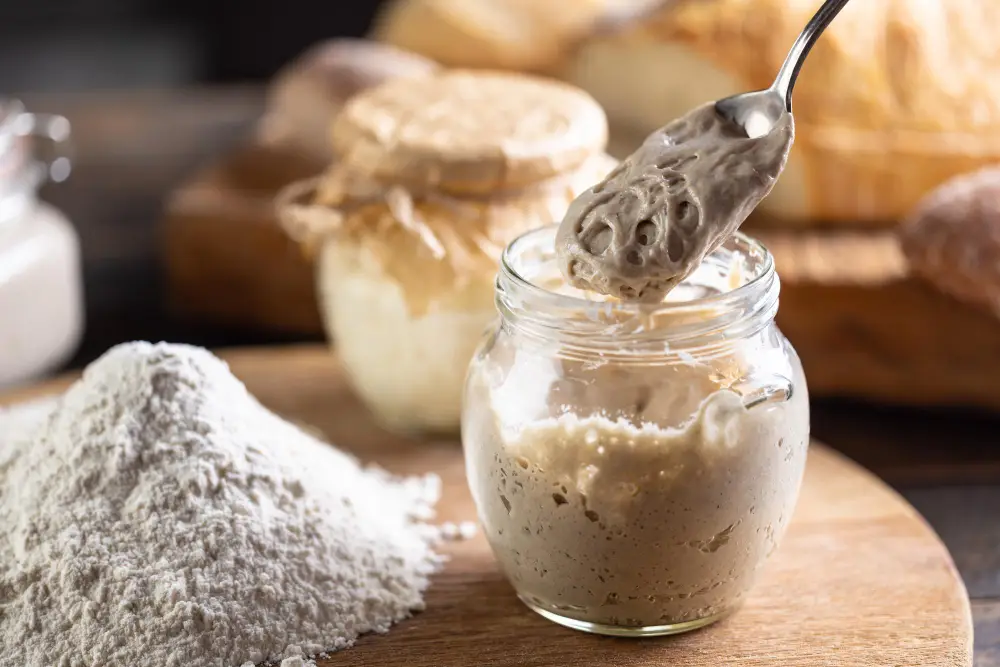
Days 4–5: Repeat the discard-and-feed once daily. You should notice more consistent bubbling, a surface that rises and falls between feedings, and a smell that gradually shifts from unpleasant to pleasantly tangy and yeasty.
Day 6 onwards: Once your starter is reliably rising and falling between feedings, move to twice-daily feeds — roughly every 12 hours. This builds strength and regularity and prepares the culture for baking.
GF starters can take 10–14 days to fully establish, especially in cooler kitchens or with certain flour types. If yours is slow, keep going.
How to Know When Your GF Starter Is Ready
The most reliable test is the float test: drop a small spoonful of starter into a glass of water. If it floats, it's full of gas and ready to use. If it sinks, give it more time.
Other signs of readiness:
- It reliably doubles in size within 4–8 hours of feeding at room temperature
- It has a consistent, pleasant sour smell
- The texture is light and bubbly throughout, not dense or gluey
- It passes the float test at its peak
Use it at or just before its peak — the point where it's fully risen but hasn't yet collapsed. Knowing exactly what that peak looks like in your specific starter, at your room temperature, with your flour, is something that develops with experience. It's also something that's genuinely easier to learn in person than from a description.
Understanding Feeding Ratios
Once your starter is established, you'll often see feeding ratios written as 1:1:1 or 1:2:2 or 1:5:5. These numbers mean:
Starter : Flour : Water (all by weight)
A smaller proportion of starter to fresh flour and water means the culture peaks more slowly; a larger proportion means it peaks faster. Adjusting the ratio lets you control the timing — so your starter peaks just when you're ready to bake rather than hours before or after.
Finding the ratio that gives you a peak at the right time for your schedule is one of those practical calibrations that becomes intuitive after a few bakes. Consistency is key — feed at the same ratio, at the same temperature, at the same time of day, and your starter will become predictable.
Does a GF Starter Behave Differently to a Wheat Starter?
Yes, in a few noticeable ways.
It may be thicker or more gel-like. GF flours absorb water differently, and some (like buckwheat) create a denser, stickier texture. This is normal. Your starter doesn't need to look like a wheat starter to be healthy.
It may not rise as dramatically. Without gluten to trap gas bubbles, GF starters tend to show a more modest rise than wheat starters. Look for a 50–100% increase in volume rather than expecting a dramatic doubling. Bubbles throughout the mixture are a more reliable indicator of activity than height alone.
It can be more sensitive to temperature. GF fermentation tends to be a little more temperature-dependent. Cold kitchens will dramatically slow things down.
Cross-Contamination: Keeping Your Starter Safe
If you or someone in your household has coeliac disease, cross-contamination is a serious concern. (Coeliac UK estimates that even small amounts of gluten — as little as 10–100mg per day — can cause intestinal damage in people with coeliac disease.)
Here's how to keep your GF starter genuinely free from gluten:
Dedicated Equipment
Use jars, spoons, scales, and bowls that are only ever used for GF baking. Label them clearly. Gluten proteins are sticky and can survive a normal hand wash — they require thorough scrubbing with hot, soapy water to remove.
Surface Hygiene
Clean your work surface thoroughly before working with your GF starter. If flour has been used on the surface recently — even if you can't see it — wipe down with a damp cloth, then a fresh one.
Storage Separation
Store your GF starter on a separate shelf from any wheat-based starters or flours. Flour dust can travel in the air and settle on open containers.
When In Doubt, Get Certified GF Flour
Not all flours labelled "naturally gluten-free" are produced in dedicated GF facilities. If you're baking for someone with coeliac disease, look for flour that carries a certified GF logo. In the UK, the Coeliac UK Crossed Grain symbol is a reliable indicator.
Long-Term Storage: Keeping Your Starter Alive Between Bakes
Room Temperature (Active Baking Mode)
If you bake two to three times a week, keep your starter at room temperature and feed it once or twice daily.
Fridge Storage (Maintenance Mode)
If you bake less frequently, store your starter in the fridge. Feed it once a week, leave at room temperature for a couple of hours to activate, then return to the fridge.
To use a fridge-stored starter, take it out the night before baking and give it one or two feeds at room temperature to wake it up. Don't bake with it straight from the cold — it won't be active enough to leaven your bread.
Common Problems and Quick Fixes
My starter isn't bubbling by Day 4. Keep going. Some GF starters take 10–14 days. Make sure your kitchen is warm enough and your water is unchlorinated.
It smells like nail polish remover. This is acetone — a sign the starter is hungry or too warm. Feed sooner, or reduce the temperature slightly.
It smells like cheese or vomit in the early days. This can happen as competing bacteria establish. Keep discarding and feeding — the right organisms should win out. If the smell persists after two weeks, start again with fresh flour.
There's liquid on top. This is called "hooch" — a sign your starter is hungry. Pour it off (or stir it back in for extra sourness) and feed immediately.
It's very thick and gluey. Some GF flours absorb a lot of water. Try increasing the water slightly in your next feed — aim for a consistency like thick pancake batter.
For a deeper dive into GF-specific issues, see our guide to Gluten-Free Sourdough Troubleshooting.
What Comes Next
A healthy GF starter is the foundation of everything. Once yours is reliably active, you're ready to move on to your first gluten-free sourdough loaf.
You might also want to explore:
- The Complete Guide to Gluten-Free Sourdough Bread — the full process from starter to finished loaf.
- Best Gluten-Free Flour Blends for Sourdough — which flours work best together and why.
- Is Sourdough Bread Easier to Digest? — what the research says about fermentation and gut health.
Want to Learn in Person?
Building a GF starter is one thing. Knowing exactly what it should look, smell, and feel like at every stage is another. In our Gluten-Free Sourdough Workshop, you'll work with a live, established starter from the very first hour — so you know exactly what you're aiming for before you go home to build your own.
Not sure which workshop is right for you? Our Classic vs Rye vs Gluten-Free comparison guide walks you through the differences.